01Medicare foundations
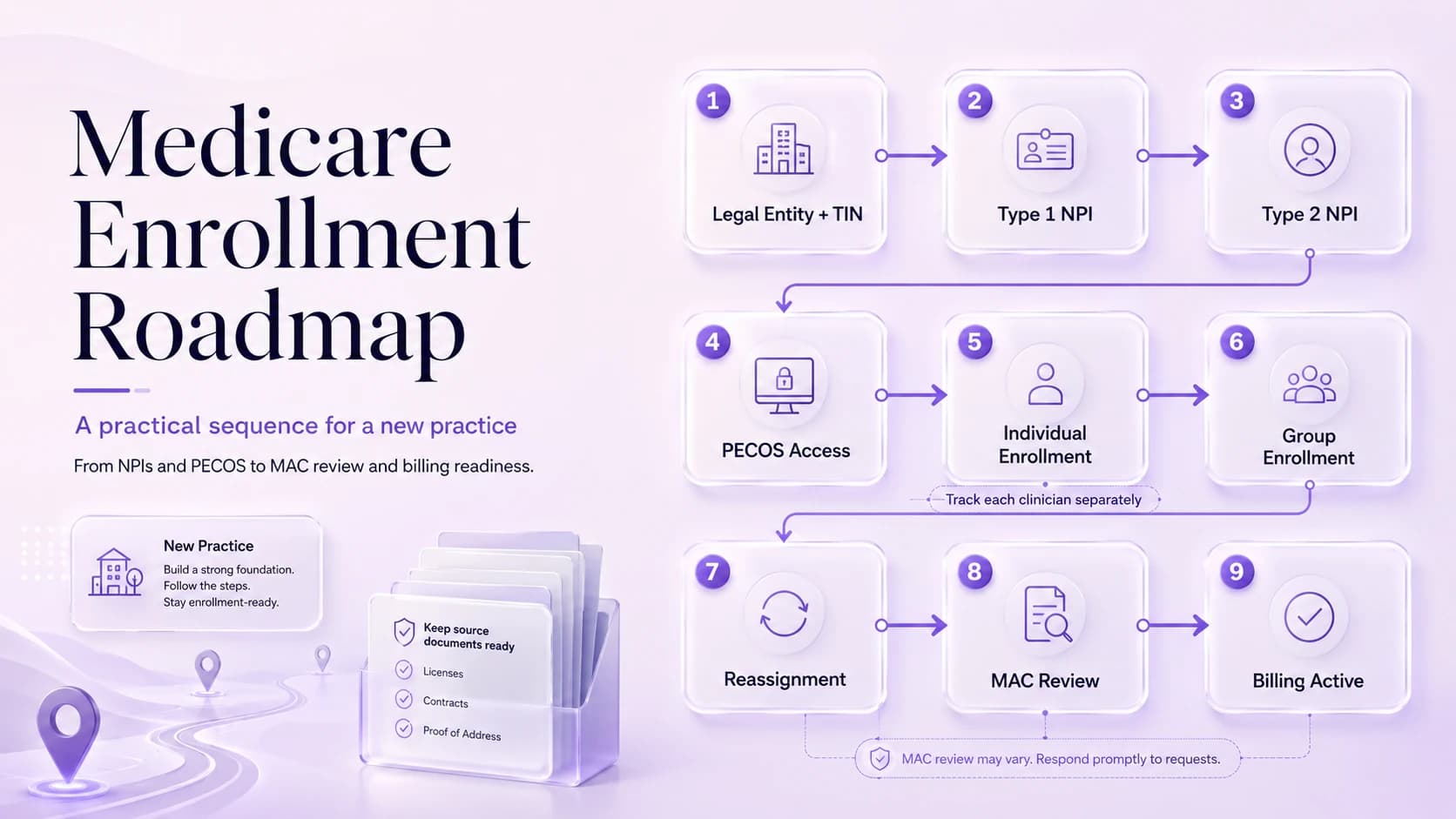
Medicare Provider Enrollment: A Practical Roadmap for a New Practice
A practical Medicare provider-enrollment sequence for a new practice: identity and NPIs first, then PECOS, group and individual records, reassignments, MAC follow-up, and billing activation.
READ GUIDE ↗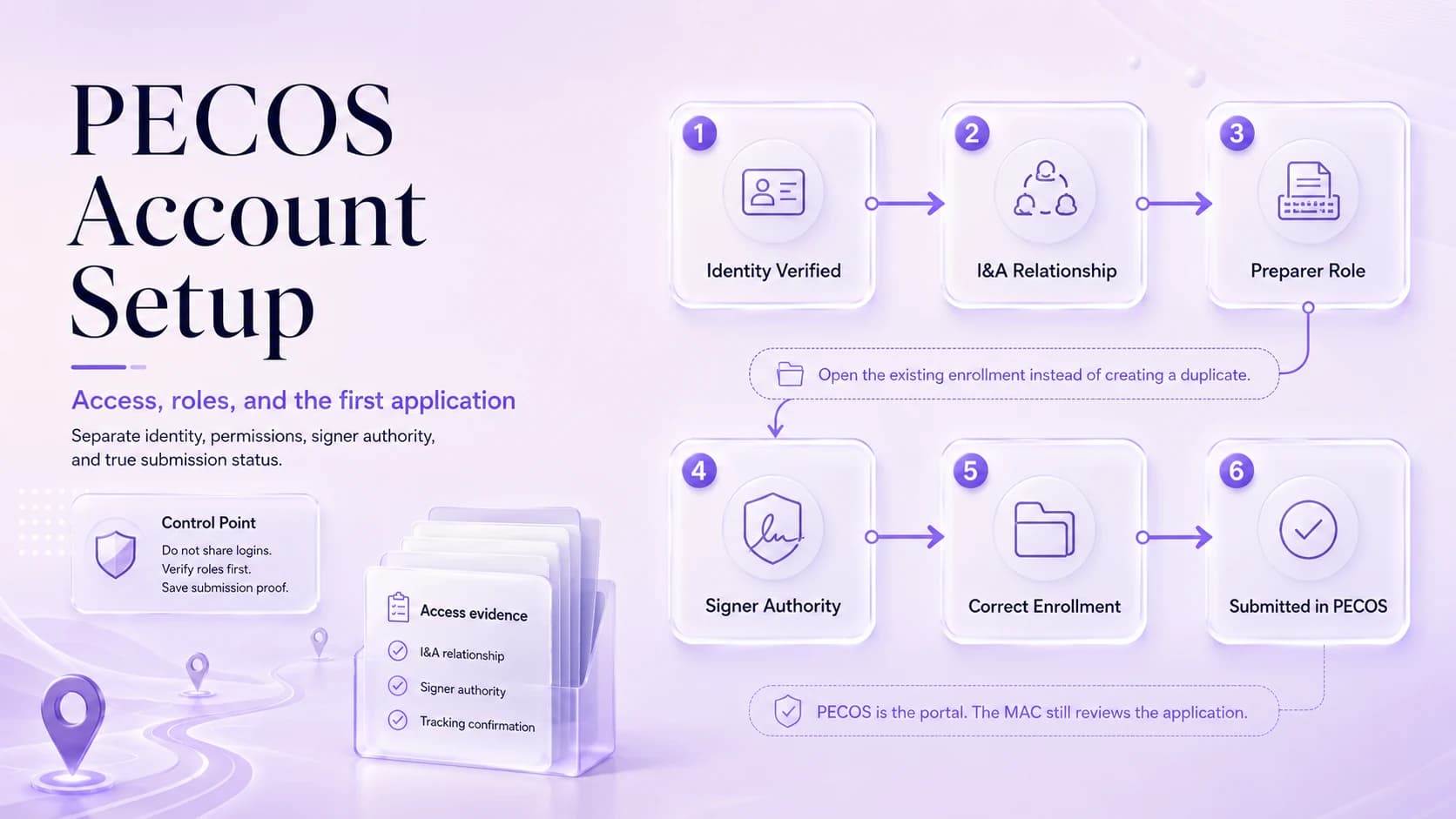
02Medicare foundations
PECOS Account Setup: Access, Roles, and the First Application
Set up PECOS access correctly by separating identity, I&A permissions, organization relationships, preparer roles, signer authority, and the application’s actual submission state.
READ GUIDE ↗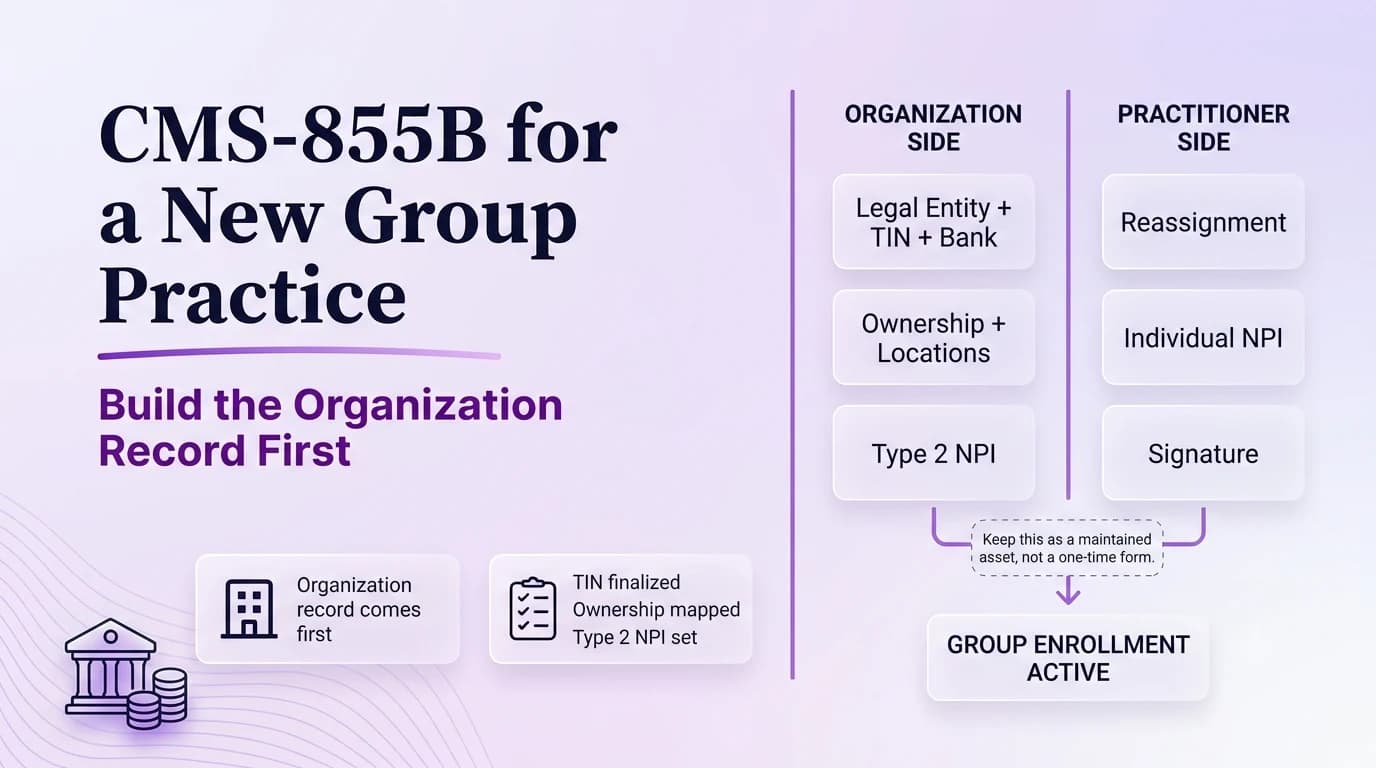
03Identifiers & NPPES
Get the NPI Right Before Medicare Enrollment
Audit the clinician and organization NPI records before Medicare enrollment so legal name, taxonomy, locations, and Type 1/Type 2 roles are correct before they spread into PECOS and payer files.
READ GUIDE ↗04Identifiers & NPPES
Type 1 vs Type 2 NPI: What a Small Practice Actually Needs
Type 1 NPIs identify individual providers; Type 2 NPIs identify eligible organizations. Map both roles before deciding how a solo or growing practice should enroll and bill.
READ GUIDE ↗05Identifiers & NPPES
Choosing and Maintaining NPI Taxonomy Codes Without Creating Enrollment Mismatches
Choose NPI taxonomy codes that accurately describe the provider, keep the primary taxonomy intentional, and prevent NPPES, Medicare, CAQH, and payer specialty records from drifting apart.
READ GUIDE ↗06Identifiers & NPPES
NPPES Data Matching Before You Submit Payer Applications
Run an NPPES data-match audit before payer applications so legal name, NPI type, taxonomy, locations, and organization identity do not conflict with PECOS, CAQH, W-9, or payer records.
READ GUIDE ↗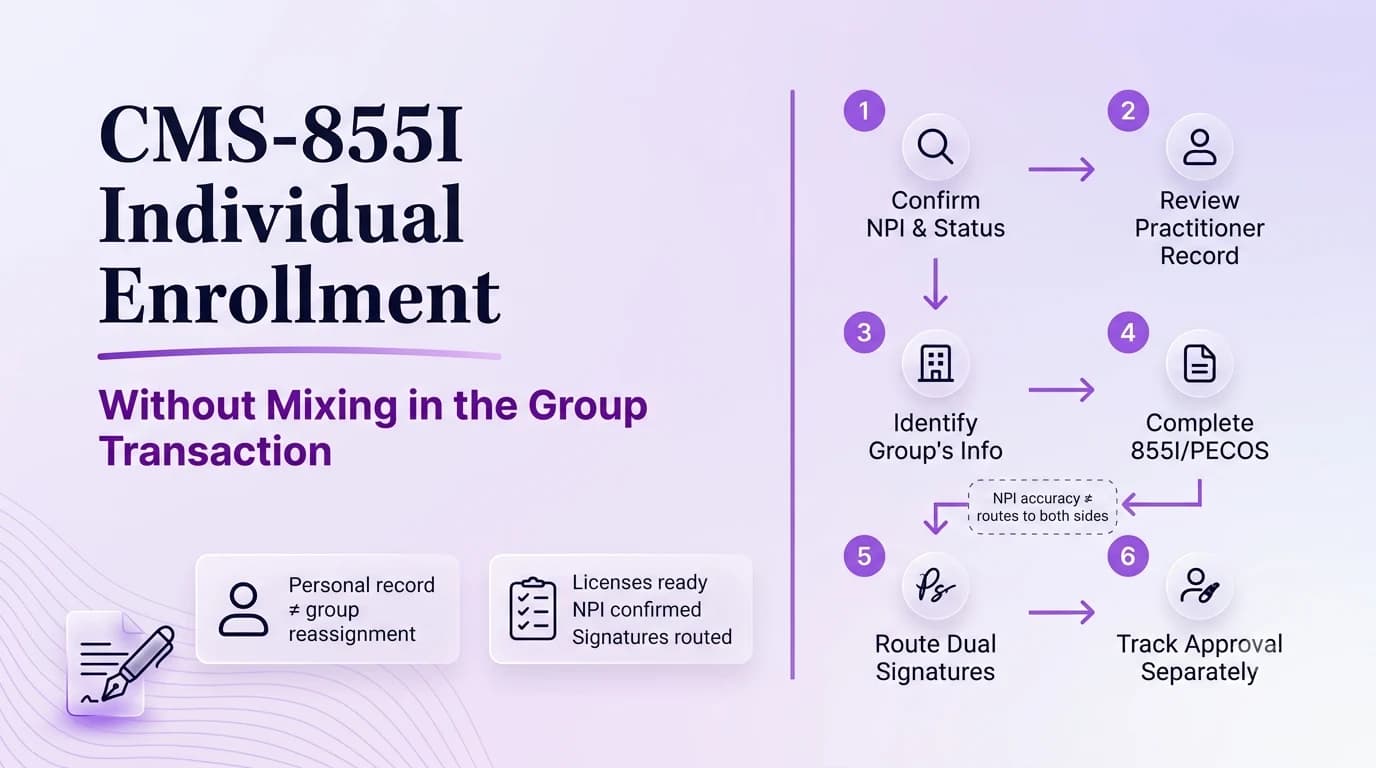
07Medicare applications
CMS-855I: Individual Medicare Enrollment Without Mixing in the Group Transaction
Use CMS-855I or PECOS to build the individual Medicare practitioner record without confusing personal enrollment, group reassignment, organization identity, and practice locations.
READ GUIDE ↗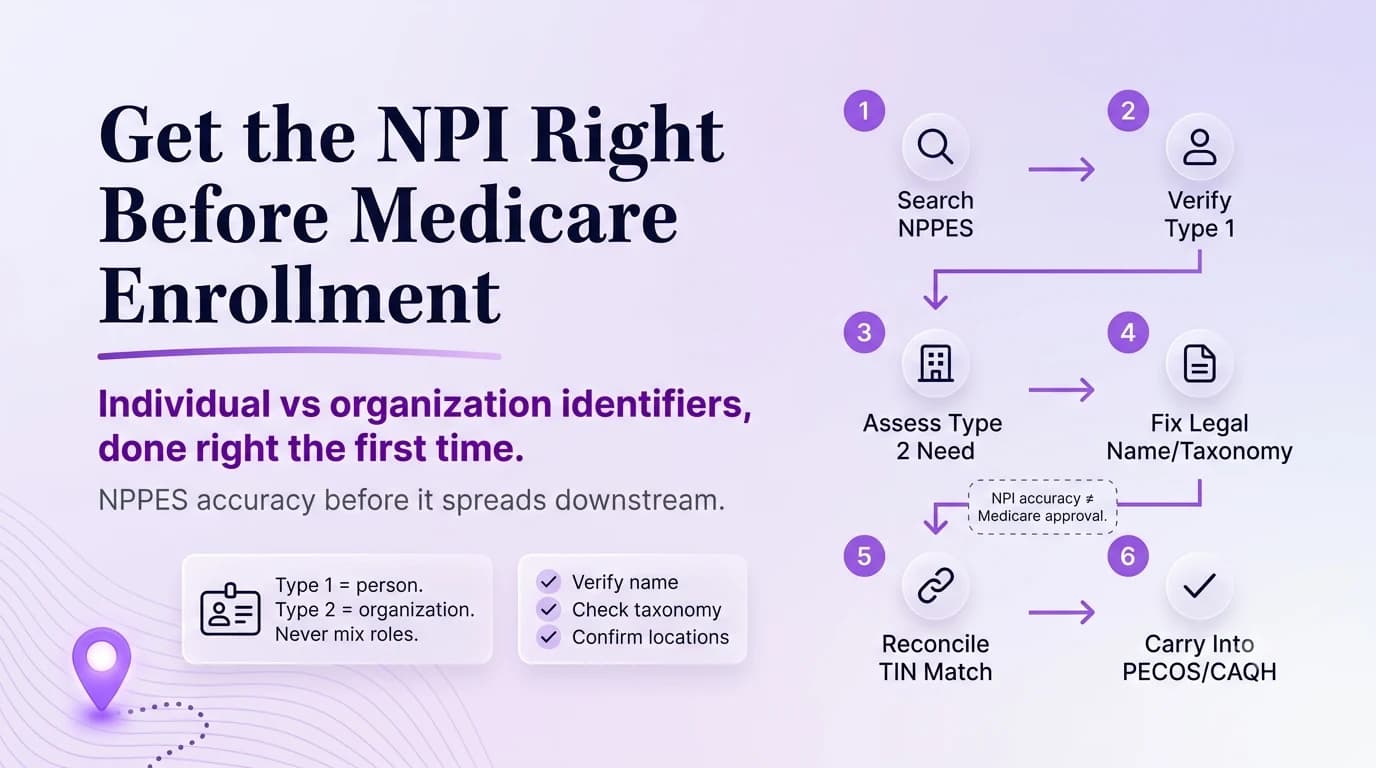
08Medicare applications
CMS-855B for a New Group Practice: Build the Organization Record First
How a new clinic or group practice should build the organization Medicare record with CMS-855B or PECOS, including legal identity, ownership, locations, banking, and 2026 form changes.
READ GUIDE ↗09Medicare applications
Medicare Reassignment After CMS-855R: What Changed and How to Track It
CMS merged the paper CMS-855R reassignment application into CMS-855I. Update old Medicare SOPs and track practitioner-to-group relationships separately from individual and group enrollment.
READ GUIDE ↗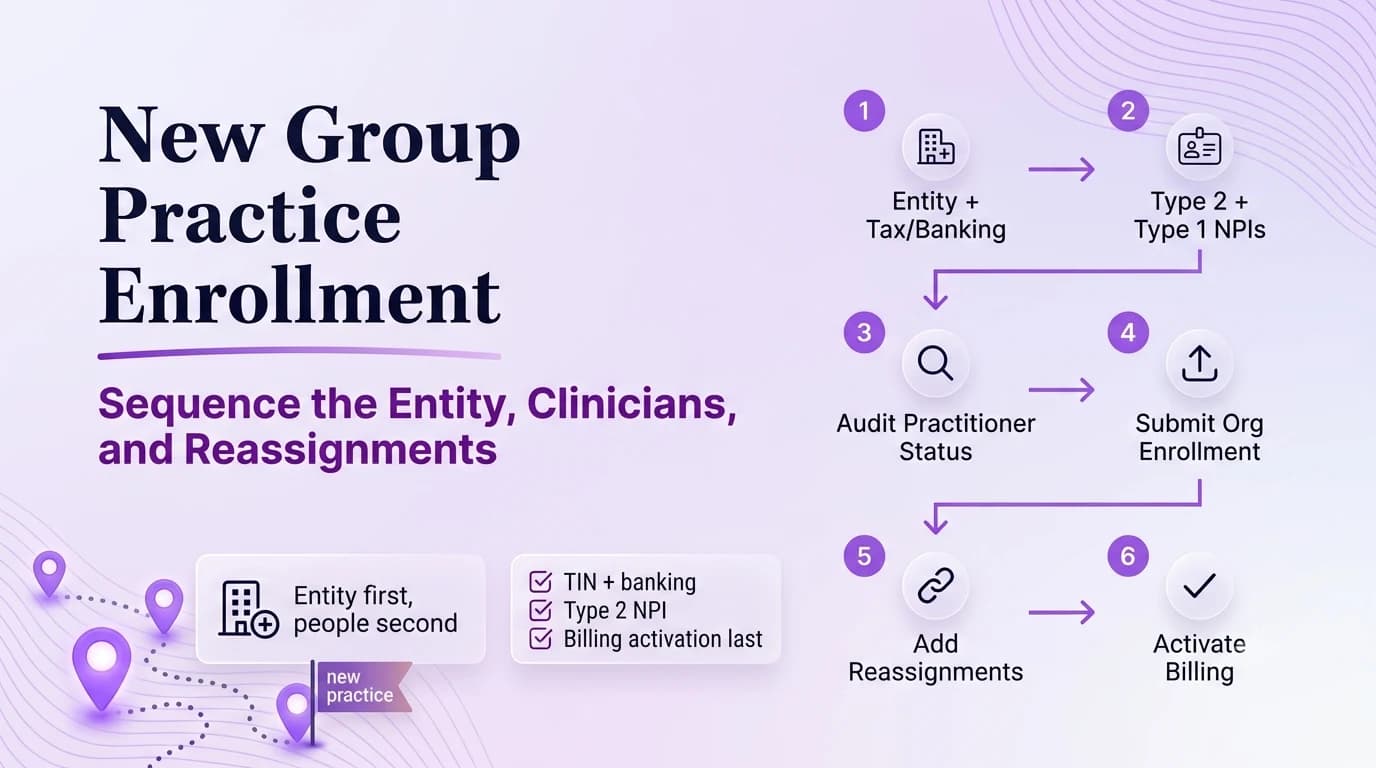
10Practice build-out
New Group Practice Medicare Enrollment: Sequence the Entity, Clinicians, and Reassignments
Sequence Medicare enrollment for a new group practice by separating organization identity, Type 2 NPI, CMS-855B/PECOS group enrollment, individual practitioners, reassignments, and billing activation.
READ GUIDE ↗11Practice build-out
Adding a New Provider to an Existing Medicare Group
A Medicare onboarding workflow for adding a provider to an existing group without confusing the group’s active enrollment with the practitioner’s individual enrollment, reassignment, and locations.
READ GUIDE ↗12Practice build-out
Adding a Medicare Practice Location: What Must Change and When
How to add a Medicare practice location without losing track of provider type, organization versus individual records, the 30-day reporting expectation, and effective-date evidence.
READ GUIDE ↗13Maintenance
Medicare Enrollment Changes: 30 Days vs 90 Days
A practical Medicare change-reporting triage: ownership, adverse legal action, and practice-location changes generally fall under 30 days; other enrollment changes generally fall under 90 days.
READ GUIDE ↗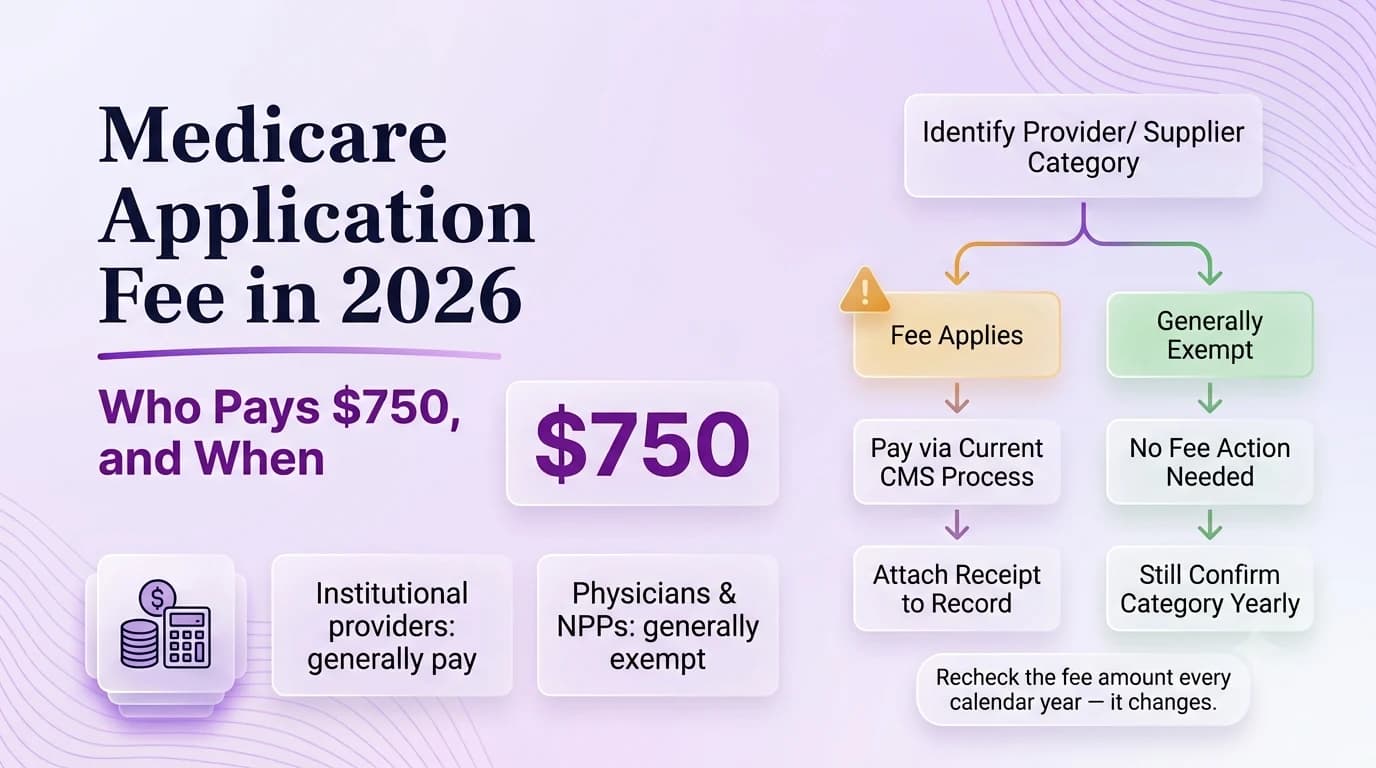
14Medicare applications
Medicare Enrollment Application Fee in 2026: Who Pays and When
The Medicare enrollment application fee is $750 in calendar year 2026 for institutional providers and suppliers subject to the fee. Physicians, non-physician practitioners, and their organizations are generally exempt.
READ GUIDE ↗15Maintenance
How to Track a Medicare Enrollment Application With the MAC
How to track a Medicare enrollment with the correct MAC using PECOS status, submission references, development requests, and a follow-up log that distinguishes activity from approval.
READ GUIDE ↗16Identifiers & NPPES
PTAN vs NPI: Why Both Numbers Show Up in Medicare Enrollment
NPI and PTAN identify different things in Medicare operations. Learn where each number comes from, when it appears, and why one should never be substituted for the other.
READ GUIDE ↗17Medicare applications
CMS-855O: Enrolling Solely to Order or Certify for Medicare
CMS-855O is for eligible physicians and practitioners enrolling in Medicare solely to order or certify covered items and services, not to submit claims for their own furnished services.
READ GUIDE ↗18Medicare applications
Medicare Opt-Out and Ordering/Certifying: Keep the Status Straight
Medicare opt-out status and ordering/certifying recognition can coexist in defined circumstances, but the practice must track affidavits, renewal periods, NPI identity, and the clinician’s non-billing role carefully.
READ GUIDE ↗19Practice build-out
Telehealth Practice Locations in Medicare Enrollment: A 2026 Update
A 2026 Medicare enrollment workflow for telehealth practice locations, including the revised CMS-855B location type, location-change reporting, and group/provider relationship controls.
READ GUIDE ↗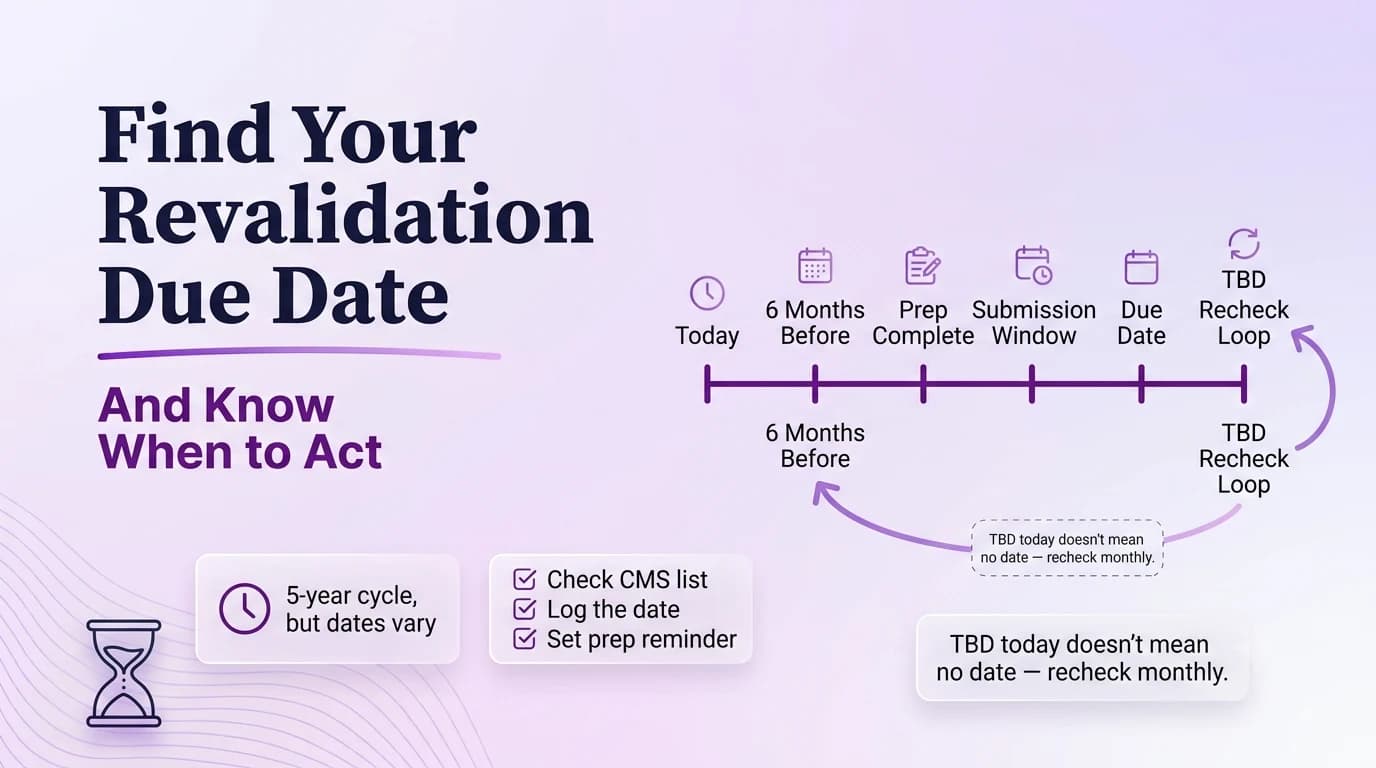
20Revalidation
How to Find a Medicare Revalidation Due Date and Know When to Act
Find the Medicare revalidation date from current CMS/PECOS information, distinguish the general five-year cycle from an assigned due date, and start preparation early enough to avoid deactivation.
READ GUIDE ↗21Revalidation
Medicare Revalidation Checklist: Audit the Record Before You Click Submit
A Medicare revalidation audit that checks identity, ownership, locations, licenses, EFT, adverse actions, reassignments, signatures, and current source documents before submission.
READ GUIDE ↗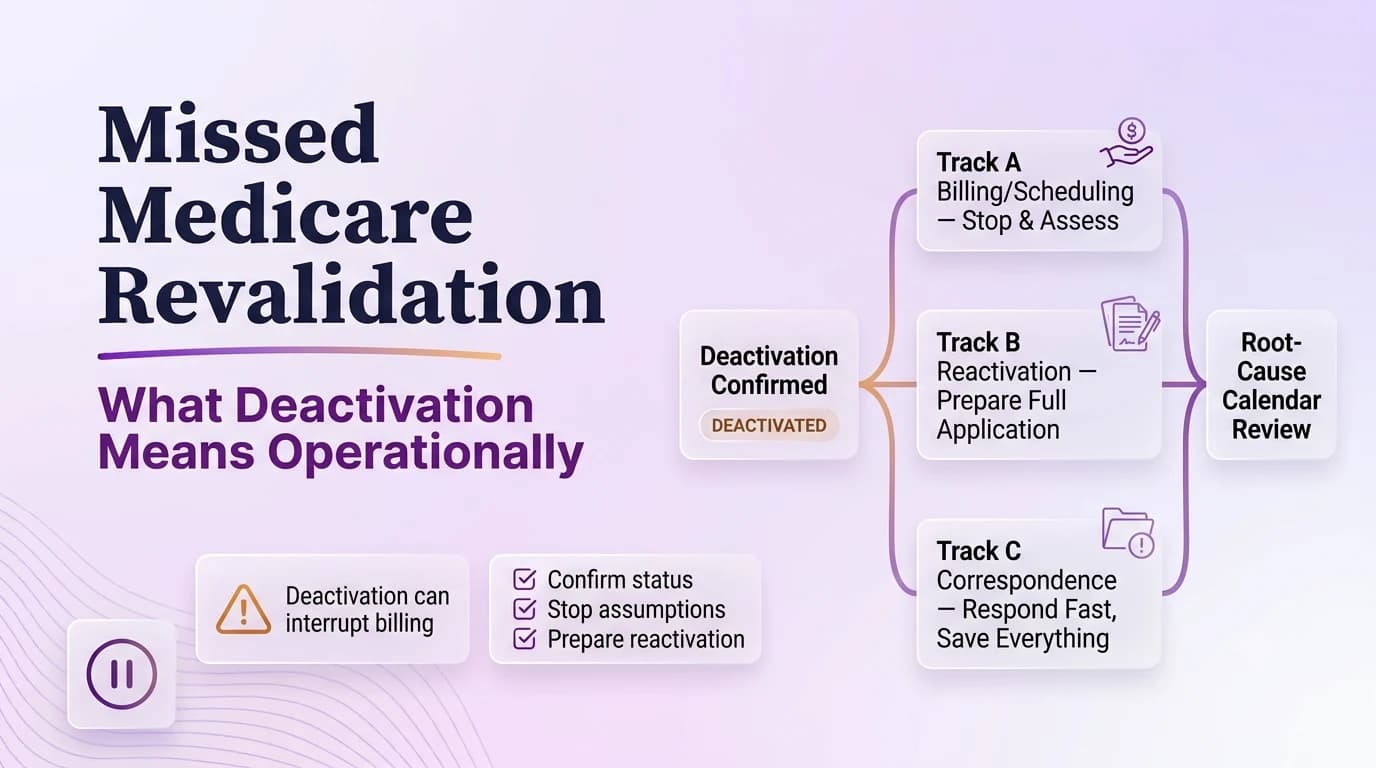
22Revalidation
Missed Medicare Revalidation: What Deactivation Means Operationally
What happens operationally after a Medicare revalidation is missed, how deactivation can interrupt billing, and how to organize reactivation work without guessing at retroactivity.
READ GUIDE ↗23Revalidation
Off-Cycle Medicare Revalidation: Why CMS May Ask Early
CMS may request Medicare revalidation outside the ordinary cycle. Here is how to treat an off-cycle request as a current-record audit rather than a surprise duplicate filing.
READ GUIDE ↗24Revalidation
Revalidation and Reassignments: Check Who Is Still Billing Through the Group
Medicare revalidation is the right time to verify which practitioners are still reassigning benefits to a group, which relationships should end, and which new affiliations were never completed.
READ GUIDE ↗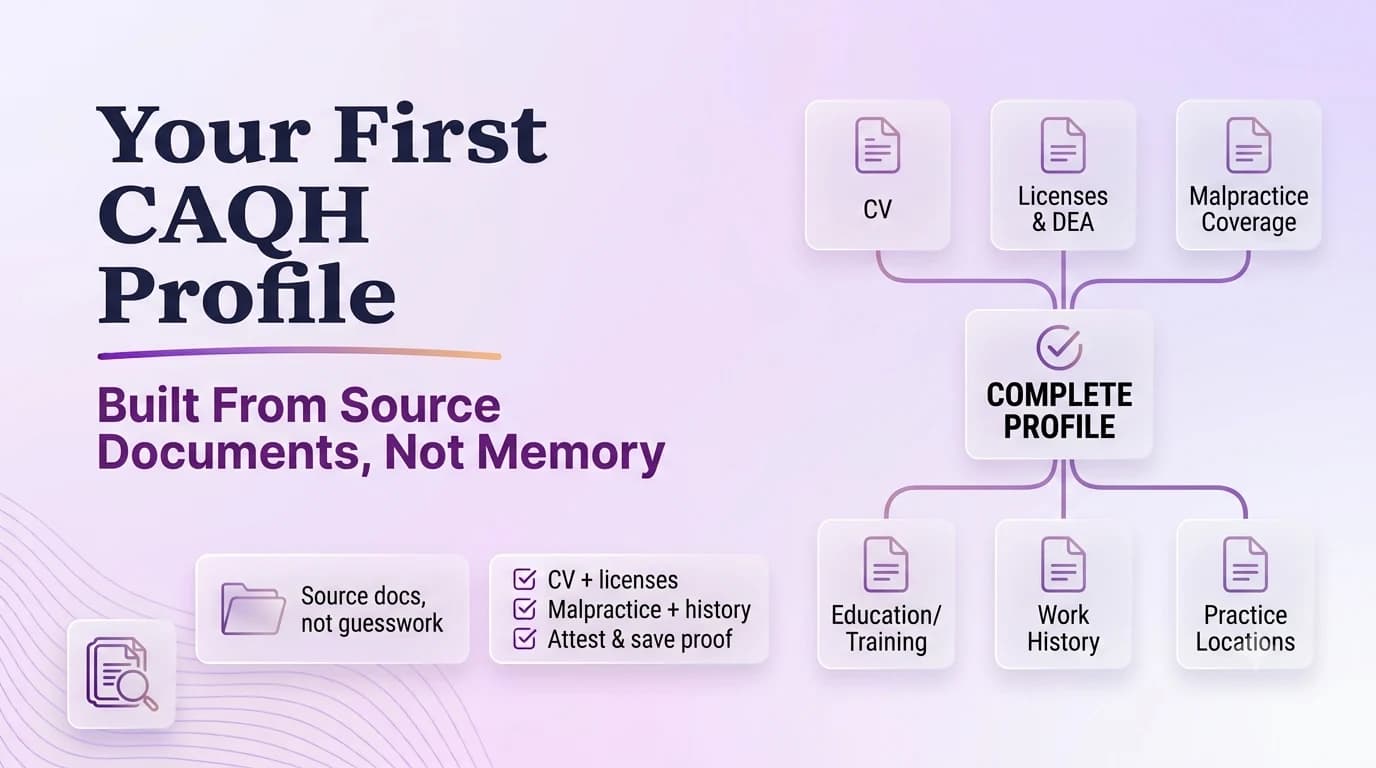
25CAQH & commercial credentialing
CAQH Provider Data Portal: Build the First Profile From Source Documents
Build a first CAQH Provider Data Portal profile from source documents, authorize the right organizations, upload current evidence, and create a maintenance record from day one.
READ GUIDE ↗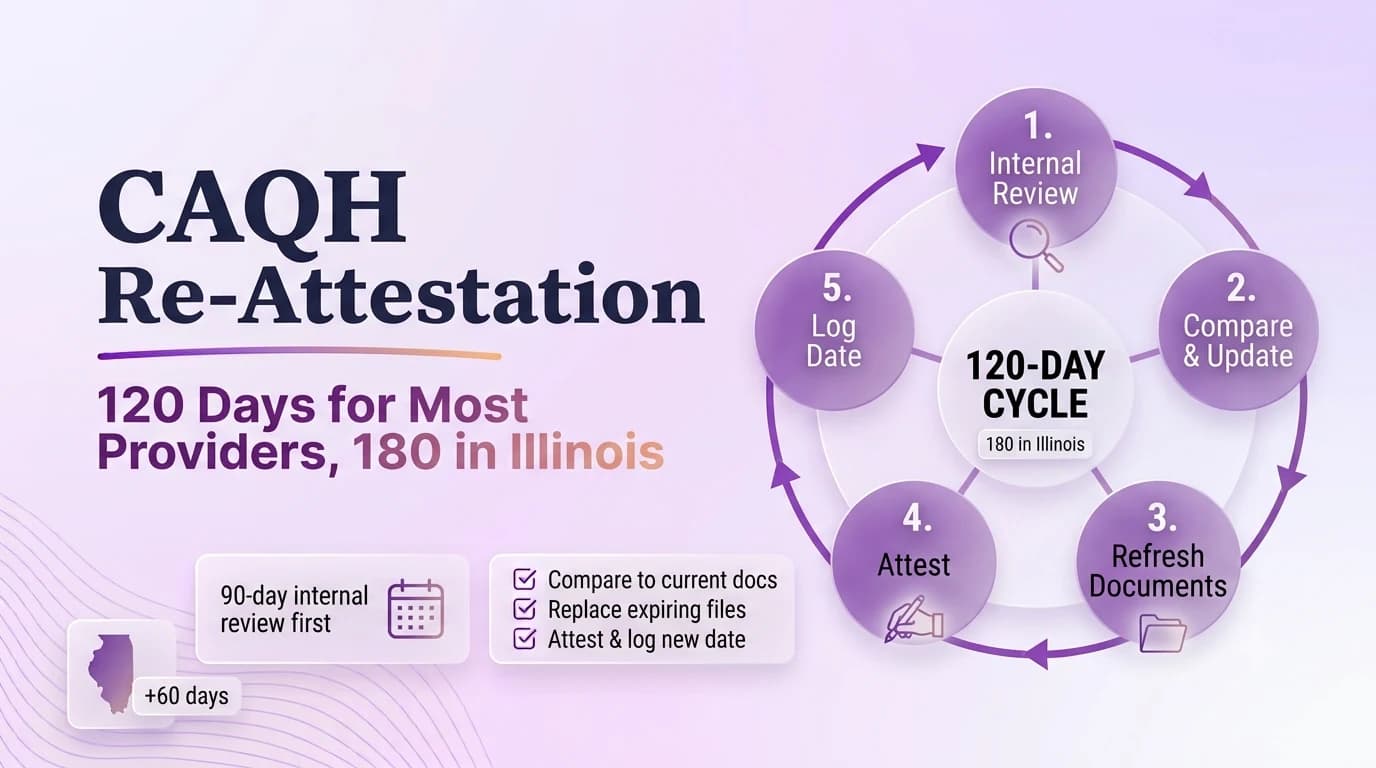
26CAQH & commercial credentialing
CAQH Re-Attestation: 120 Days for Most Providers, 180 Days in Illinois
A CAQH re-attestation workflow that reflects the current 120-day cadence for most providers and 180-day cadence for providers practicing in Illinois, with document and change controls built in.
READ GUIDE ↗27CAQH & commercial credentialing
CAQH Practice-Location Review: What the 90-Day Response Window Means
CAQH can present health-plan-submitted locations for provider review; unresolved requests can be reported as No Response after 90 days. This is not a universal 90-day location attestation cycle.
READ GUIDE ↗28CAQH & commercial credentialing
CAQH Document Expiration: Prevent a Complete Profile From Becoming Unusable
Prevent a CAQH profile from becoming unusable because a license, malpractice certificate, DEA record, or other supporting document expired while the narrative profile stayed accurate.
READ GUIDE ↗29CAQH & commercial credentialing
CAQH vs Payer Credentialing: What CAQH Does—and What It Does Not Finish
CAQH can supply standardized provider data to authorized organizations, but it does not replace a payer’s credentialing, contracting, enrollment, product, roster, or effective-date decisions.
READ GUIDE ↗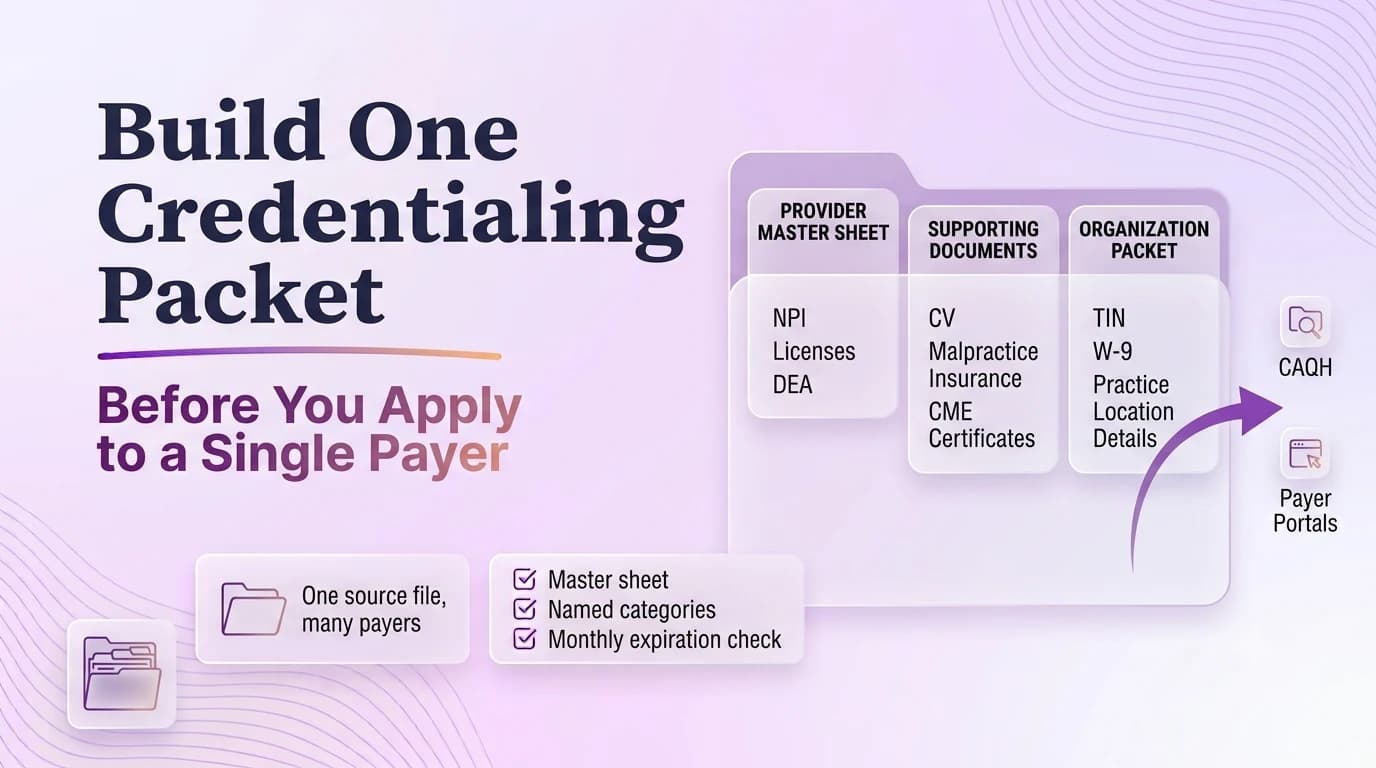
30Commercial payer operations
Commercial Payer Credentialing Packet: Build One Source File Before Applying
Build a reusable commercial payer credentialing packet from authoritative source documents so each application starts from current facts instead of the last payer form.
READ GUIDE ↗31Commercial payer operations
Build a Payer Enrollment Tracker That Shows the Next Action, Not Just the Status
A payer enrollment tracker should show the next required action, dependency, owner, evidence, and effective date—not merely a vague status such as pending.
READ GUIDE ↗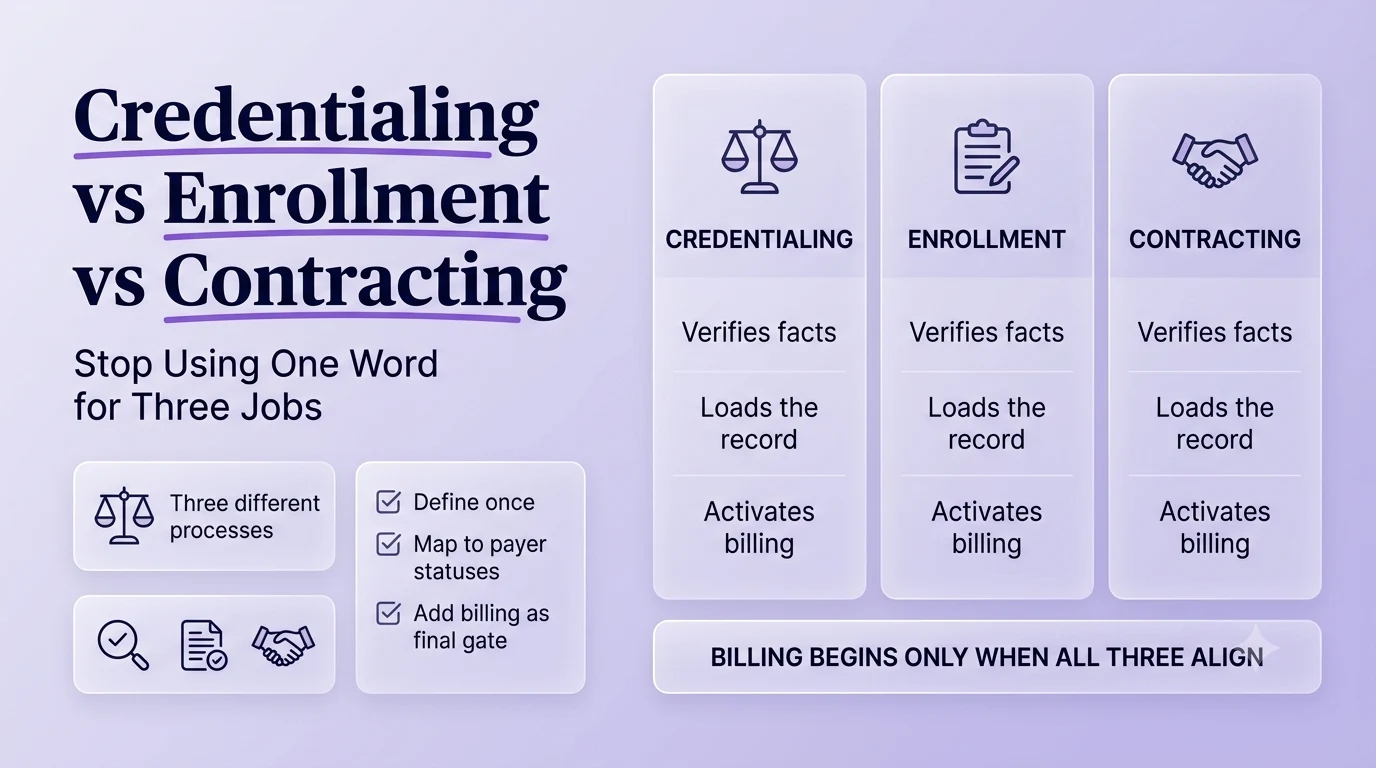
32Commercial payer operations
Credentialing vs Enrollment vs Contracting: Stop Using One Word for Three Jobs
Credentialing, enrollment, and contracting solve different payer problems. Separate them so the practice knows what is verified, what is loaded, what is contracted, and when billing can begin.
READ GUIDE ↗33Practice build-out
Credentialing the First Clinician in a New Practice: A 12-Week Operating Plan
A 12-week payer-onboarding plan for a practice’s first clinician, sequencing source documents, identifiers, CAQH, Medicare, commercial payers, contracting, and launch controls.
READ GUIDE ↗34Clinician onboarding
Nurse Practitioner Payer Enrollment: Map the Individual, Group, and State Rules
A nurse practitioner enrollment workflow that separates individual identity, organization affiliation, Medicare status, state scope rules, prescriptive credentials, and payer-specific network requirements.
READ GUIDE ↗35Clinician onboarding
Physician Assistant Enrollment: Update Old Medicare SOPs Before the Next Hire
Update physician assistant enrollment SOPs for current Medicare rules: PAs may enroll individually, receive direct payment, form groups, and reassign benefits, while state and commercial payer requirements still vary.
READ GUIDE ↗36Clinician onboarding
Therapist Payer Enrollment: Keep Licensure, Taxonomy, CAQH, and Network Status Aligned
A practical enrollment workflow for therapists that keeps state licensure, NPI taxonomy, CAQH data, group relationships, and payer network status from drifting apart.
READ GUIDE ↗37Clinician onboarding
Mental Health Counselor Medicare Enrollment: Build the File Around Current Eligibility
How mental health counselors can build a Medicare enrollment file around current eligibility rules, CMS-855I data, state licensure, supervised experience, and group reassignment.
READ GUIDE ↗38Identifiers & NPPES
When a New Practice Needs a Group NPI: Build the Organization Identity Once
A decision guide for when a new medical or behavioral health practice needs a Type 2 organization NPI and how to keep it distinct from each clinician’s Type 1 NPI.
READ GUIDE ↗39Identifiers & NPPES
Legal Business Name and TIN Matching Across NPPES, PECOS, W-9, and Payers
How to keep legal business name, DBA, TIN, NPI, W-9, NPPES, PECOS, and payer records aligned without treating every name field as interchangeable.
READ GUIDE ↗40Maintenance
Change of Ownership: Build an Enrollment Impact Map Before the Transaction Closes
An enrollment impact map for medical-practice ownership changes, covering Medicare reporting, NPIs, TINs, payer contracts, EFT, locations, and practitioner relationships before closing.
READ GUIDE ↗41Commercial payer operations
Credentialing File Audit Before Submission: A 30-Minute Control That Prevents Weeks of Development
A focused 30-minute credentialing audit that checks identity joins, dates, locations, qualifications, relationships, signatures, and attachments before a payer application leaves the office.
READ GUIDE ↗42Maintenance
Provider Enrollment Maintenance Calendar: Put Every Renewal and Attestation on One Timeline
Build one provider-enrollment maintenance calendar for Medicare revalidation, CAQH attestation, licenses, insurance, payer recredentialing, directory work, and event-driven changes.
READ GUIDE ↗