Get the NPI Right Before Medicare Enrollment
Audit the clinician and organization NPI records before Medicare enrollment so legal name, taxonomy, locations, and Type 1/Type 2 roles are correct before they spread into PECOS and payer files.
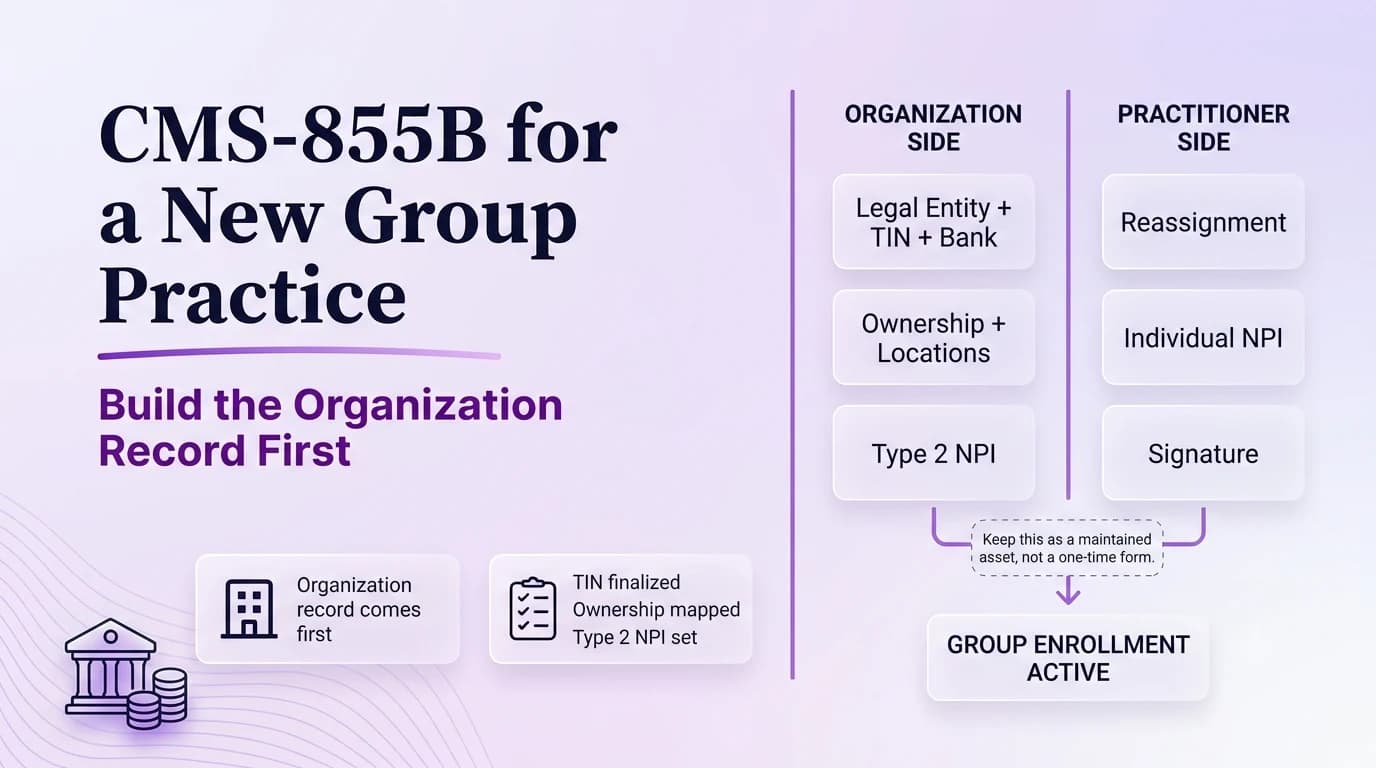
The NPI is one of the first Medicare enrollment dependencies and one of the easiest records to misuse. A clinician who changes employers normally keeps the same Type 1 NPI; forming a new practice does not create a reason to enumerate the person again. The practice may also need a Type 2 NPI for an eligible organization, but that number identifies the organization rather than replacing the clinician. Before PECOS, review NPPES for legal name, taxonomy, mailing and practice-location information, and the organization identity that will be used downstream. CMS explicitly separates NPI issuance from licensure and credentialing, so treat the NPI as a stable identifier whose data must be accurate—not as proof that Medicare or any payer approved the provider.
Search NPPES before creating any new individual identifier
CMS instructs applicants to obtain an NPI through NPPES before completing Medicare enrollment.
An NPI is a unique health care provider identifier; it is separate from Medicare enrollment and separate from credentialing.
CMS warns that issuance of an NPI does not validate that a provider is licensed or credentialed.
Search the NPI Registry for the clinician using legal name and known professional information. Verify that the Type 1 NPI belongs to the person and review the public record for obvious stale data. A change of employer, practice brand, or service location normally calls for updating the existing individual record rather than applying for a second Type 1 NPI. If two individual NPIs appear for the same person, investigate the history and follow NPPES guidance before choosing one for enrollment. Do not guess based on which number the clinician remembers using most recently.
Decide whether the legal organization needs its own Type 2 NPI
NPPES supports individual and organizational provider records and publishes practice-location reference data.
A provider’s NPPES information should be maintained as facts change rather than recreated casually.
Treat the NPI as an identifier, not an approval badge. It should describe the provider accurately before it is copied into every downstream enrollment system.
For the business, determine whether the legal entity is an eligible health care provider organization that should be enumerated as Type 2. The presence of an LLC suffix alone does not answer the question. Map the entity, TIN, ownership, billing role, and future group model. If a Type 2 NPI already exists under a prior legal or DBA name, reconcile it before creating another. Keep the organization NPI with the exact legal name and tax identity so automated Medicare and payer validations are less likely to encounter mismatched records.
Repair legal name, taxonomy, and location data before copying it downstream
Review NPPES data before the Medicare application. Correct legal name changes, taxonomy, contact information, and practice-location data through the authoritative process. For taxonomy, choose codes that accurately describe the provider’s current role and do not add a large collection merely to satisfy every payer dropdown. If a correction is submitted, record the date and verify the NPPES record after processing. Downstream systems may not refresh immediately, so the tracker should distinguish “NPPES update submitted” from “new data visible and ready to use.”
Use Type 1 for the individual and Type 2 for the organization in their proper roles
Creating a second Type 1 NPI for the same individual without a valid reason. A brief second-person check before submission is usually faster than answering a development request after the fact.
Using the group NPI where a payer or CMS transaction requires the rendering clinician’s individual NPI. When this happens, correct the source record first and then update the downstream copies that are actually affected.
Leaving an old practice address or taxonomy in NPPES and then submitting conflicting payer records. Do not bury this under a generic “pending” label. Name the blocker, the owner, and the next action.
Assuming NPI activation equals payer enrollment approval. A copied prior application is especially risky here because an old file can be internally consistent and still be wrong for the current facts.
Create a two-column identifier map. The individual side contains clinician legal name, Type 1 NPI, license/specialty, and individual Medicare record. The organization side contains legal business name, TIN, Type 2 NPI, group Medicare enrollment, and EFT/payment entity. Then draw the reassignment or group relationship between them. This prevents the common error of entering the group NPI in an ordering or rendering-provider field or using the individual NPI as the organization billing identifier merely because the owner is a solo practitioner.
Record NPI changes with dates instead of creating replacement numbers casually
Npi registry result: Store it with the transaction rather than in a personal downloads folder or one coordinator’s inbox.
Nppes profile details: Tie the document to the specific field or decision it supports.
Legal business name and tin source: Record where it came from and when someone verified it.
Taxonomy selection notes: Preserve the prior version when an effective-date sequence could matter in a later review.
Practice-location inventory: Keep the current version and enough history to show when it changed.
NPI maintenance should preserve history. If a provider changes legal name, taxonomy, or location, update the existing record as appropriate and note the effective or update date. If an organization restructures and truly needs a different NPI because the enumerated organization changes, document the before/after entities and do not overwrite the old identifier in historical files. Claims, payer correspondence, and prior contracts may still reference the old record. The identifier archive should answer which NPI belonged to which legal provider on a historical date.
Carry one verified identifier map into PECOS, CAQH, billing, and commercial payers
Use the verified map everywhere else. PECOS, CAQH, commercial payer applications, clearinghouse setup, practice-management configuration, and internal rosters should start from the same NPI source sheet. Payer-specific display labels can be documented as exceptions without changing the master identity. When one system rejects the NPI, investigate the join—name, taxonomy, TIN, provider type, location—rather than assuming the number itself is wrong. This upstream discipline prevents the practice from creating several conflicting versions of the same provider record.
Operational checklist
- Search the NPI Registry and confirm whether the clinician already has an individual record.
- Review name, taxonomy, mailing, and practice-location information for accuracy.
- Determine whether the legal organization needs its own Type 2 NPI.
- Align the organization’s legal name and tax information before using the Type 2 NPI in enrollment.
- Use the NPI values consistently in PECOS, CAQH, and payer files.
- Keep a dated identifier sheet so future changes are made deliberately instead of from memory.
Frequently asked questions
Does a clinician get a new NPI when changing employers?
Normally no. A Type 1 NPI identifies the individual and generally follows the clinician across employers. Update NPPES information as needed instead of obtaining a duplicate individual NPI.
Can one individual NPI be used at multiple practice locations?
Yes, an individual NPI can identify the same clinician across multiple legitimate locations. The NPPES, Medicare, payer, and state records still need to reflect the applicable location relationships.
Why can a payer say the NPI does not match even when the number is valid?
The payer may be validating the NPI together with legal name, TIN, taxonomy, provider type, or location. Check the full identity combination and upstream records rather than changing the NPI blindly.