Credentialing vs Enrollment vs Contracting: Stop Using One Word for Three Jobs
Credentialing, enrollment, and contracting solve different payer problems. Separate them so the practice knows what is verified, what is loaded, what is contracted, and when billing can begin.
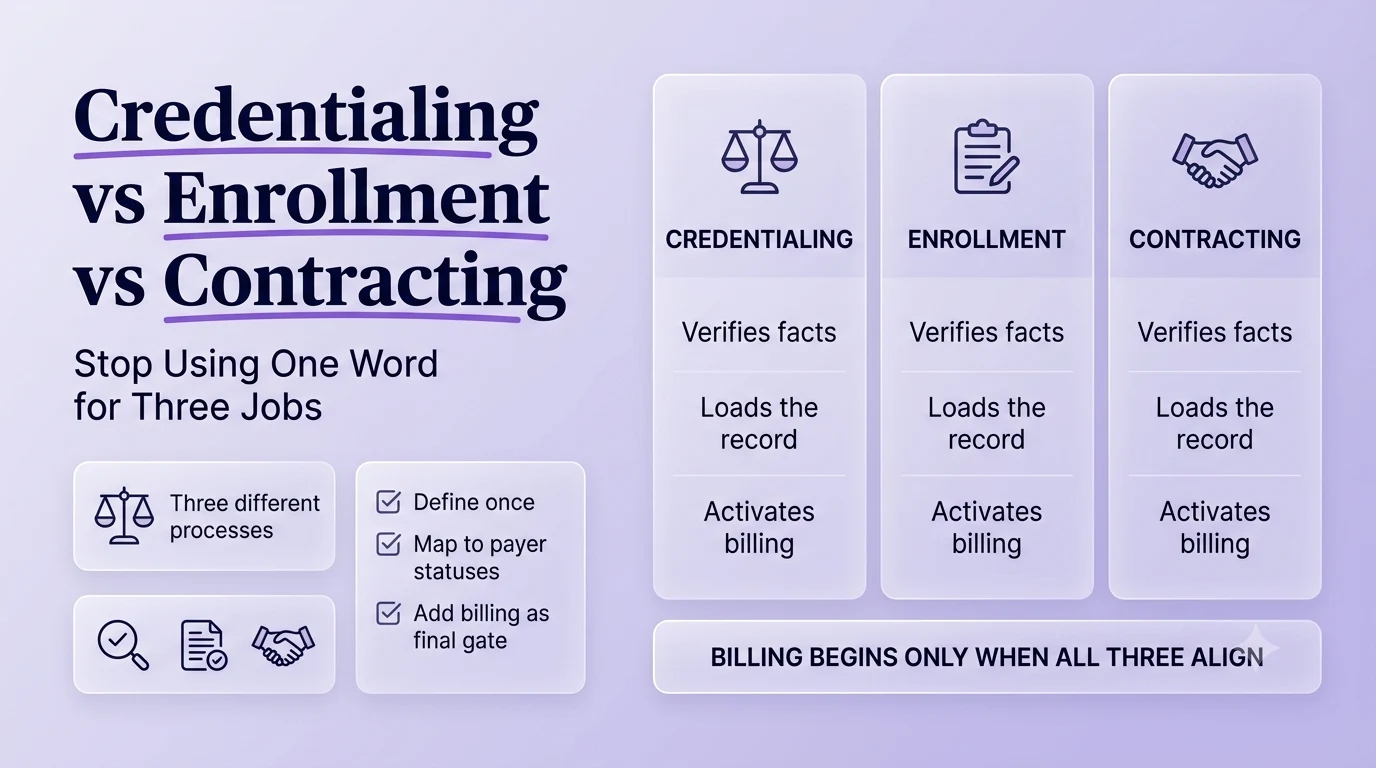
Health care offices often use “credentialing” as a catch-all for every task required to join a payer. That shorthand causes operational mistakes because credentialing, enrollment, and contracting answer different questions. Credentialing is the payer’s verification and evaluation of the clinician’s professional qualifications. Enrollment generally creates or updates the payer’s provider and billing relationship in its systems. Contracting establishes the legal participation terms between the payer and the practitioner or organization. A payer may combine the workflows in one portal, but the practice should still track the concepts separately. When a clinician is “approved,” staff need to know approved for what, under which entity and product, and whether a usable effective date exists.
Credentialing asks whether the clinician meets professional participation standards
Credentialing generally evaluates the clinician’s qualifications and professional history.
Contracting establishes participation terms between the payer and provider/entity.
Enrollment is the operational setup that connects approved providers and organizations to the payer’s claims/payment systems.
Credentialing usually involves professional identity, licensure, education and training, work history, malpractice coverage and history, sanctions or exclusions, board status where relevant, peer references or attestations, and other qualification criteria. CAQH may supply much of the data, but the payer or credentialing organization performs the review. Credentialing approval tells the practice something important about qualifications; it does not necessarily prove that a contract is signed or that claims can be submitted under the intended group. Store the credentialing decision date and any recredentialing cycle separately from the billing activation record.
Enrollment asks how the provider is represented in the payer’s operational systems
Some payers combine these steps, but the underlying milestones still differ.
Medicare uses its own enrollment and reassignment terminology, so commercial-payer shorthand should not be copied into CMS workflows.
Language drives operations. Three distinct columns prevent the word “credentialed” from hiding an unfinished contracting or enrollment step.
Enrollment is the operational representation of the provider inside the payer’s systems. It can include identifiers, tax entity, billing group, locations, specialty, product, EFT or remit information, roster relationships, and effective dates. Some plans call this provider setup or loading rather than enrollment. The name matters less than the function: the payer must know which practitioner is rendering, which entity is billing, and where the relationship applies. A clinician can pass credentialing but still have an enrollment defect, such as being attached to the wrong TIN or missing a practice location. That is why the tracker needs a distinct enrollment/loading stage after credentialing when the payer workflow requires it.
Contracting defines the legal network relationship and its products
Contracting concerns the participation agreement. The contracting party may be an individual, group, or other organization depending on the structure. The agreement can define products, reimbursement methodology, notice duties, term and termination rules, assignment, and other legal terms. Credentialing staff should not interpret contract language beyond their role, but they do need to know whether an executed agreement is required before the payer will activate the clinician. Store signature dates, legal entity, products, and the final executed copy. If a group already has a contract, adding a provider may require only credentialing and roster/enrollment work; do not generate a new contract simply because a new clinician joins.
One payer portal can hide three separate finish lines
Telling scheduling that a provider is in-network after credentialing approval alone. If one field changed, review the related identifiers, addresses, dates, and relationships instead of patching only the item mentioned in a portal message.
Assuming a signed contract has already loaded every product and location. The problem is not merely cosmetic: a mismatch can change which transaction is reviewed or where the request is routed.
Using “credentialing date” when the real question is network effective date. This tends to surface later, when billing or scheduling discovers that a supposedly completed file still has an unresolved dependency.
Failing to define what “complete” means in the tracker. A brief second-person check before submission is usually faster than answering a development request after the fact.
Payer interfaces can collapse all three concepts into a single case number. The practice can still maintain internal sub-statuses. When a portal says “approved,” review the message and determine whether it refers to professional credentialing, network participation, contract execution, provider loading, or a final effective date. If the wording is ambiguous, ask a narrower question: Is the clinician active under this group TIN at this location for this product as of this date? Record the answer and reference. Narrow questions produce operationally useful evidence; broad questions such as “is credentialing done?” often produce a yes that billing cannot safely use.
Use evidence and dates that correspond to the stage being claimed complete
Credentialing approval: Use a filename that includes the provider or entity, document type, and the date that matters.
Contract document: Store it with the transaction rather than in a personal downloads folder or one coordinator’s inbox.
Network effective date: Tie the document to the specific field or decision it supports.
Enrollment/portal confirmation: Record where it came from and when someone verified it.
Billing test evidence: Preserve the prior version when an effective-date sequence could matter in a later review.
Match evidence to claims. Credentialing complete should point to a committee or payer credentialing notice. Contract complete should point to the executed agreement or payer confirmation that the group agreement governs the provider. Enrollment/loading complete should point to a roster, portal record, or payer setup confirmation. Network effective should point to the payer-recognized date and scope. Do not let one document stand in for every stage unless the payer explicitly combines them in that document. Separate dates also make delays diagnosable: a file may spend five days in credentialing and six weeks waiting for contracting or loading, which suggests a different process problem than slow primary-source verification.
Teach scheduling and billing teams a vocabulary that prevents premature activation
Front-desk and billing language should be equally precise. Instead of saying “Dr. Lee is credentialed,” a launch note can say “Payer X PPO: active under ABC Medical Group, Main Street location, effective September 1; HMO still pending.” That wording tells schedulers what they may represent to patients and tells billing which relationship is usable. Train staff not to infer network status from a CAQH profile, application receipt, or credentialing committee approval. The goal is not vocabulary for its own sake. It is preventing care from being scheduled or claims configured against a payer relationship that has not reached the stage required for that action.
Operational checklist
- Define the practice’s terms in one SOP.
- Map each payer’s portal statuses to those internal stages.
- Track credentialing approval, contract execution, and effective date separately.
- Add claims/payment setup as a final operational gate.
- Train scheduling and billing to use the effective-status field, not email wording.
- Reconcile exceptions when a payer combines stages or backdates an effective date.
Frequently asked questions
Is credentialing the same as joining a payer network?
Not necessarily. Credentialing evaluates professional qualifications. Network participation may also require contracting, enrollment or provider loading, group affiliation, product assignment, and an effective date.
Can a clinician be credentialed but not billable through the group?
Yes. The professional review may be complete while the group relationship, contract, roster, tax entity, location, or effective date remains unfinished.
Why track separate dates if a payer uses one portal case?
Because the operational milestones may still differ. Separate dates reveal what is actually complete and prevent an early credentialing approval from being mistaken for final network activation.