CMS-855I: Individual Medicare Enrollment Without Mixing in the Group Transaction
Use CMS-855I or PECOS to build the individual Medicare practitioner record without confusing personal enrollment, group reassignment, organization identity, and practice locations.
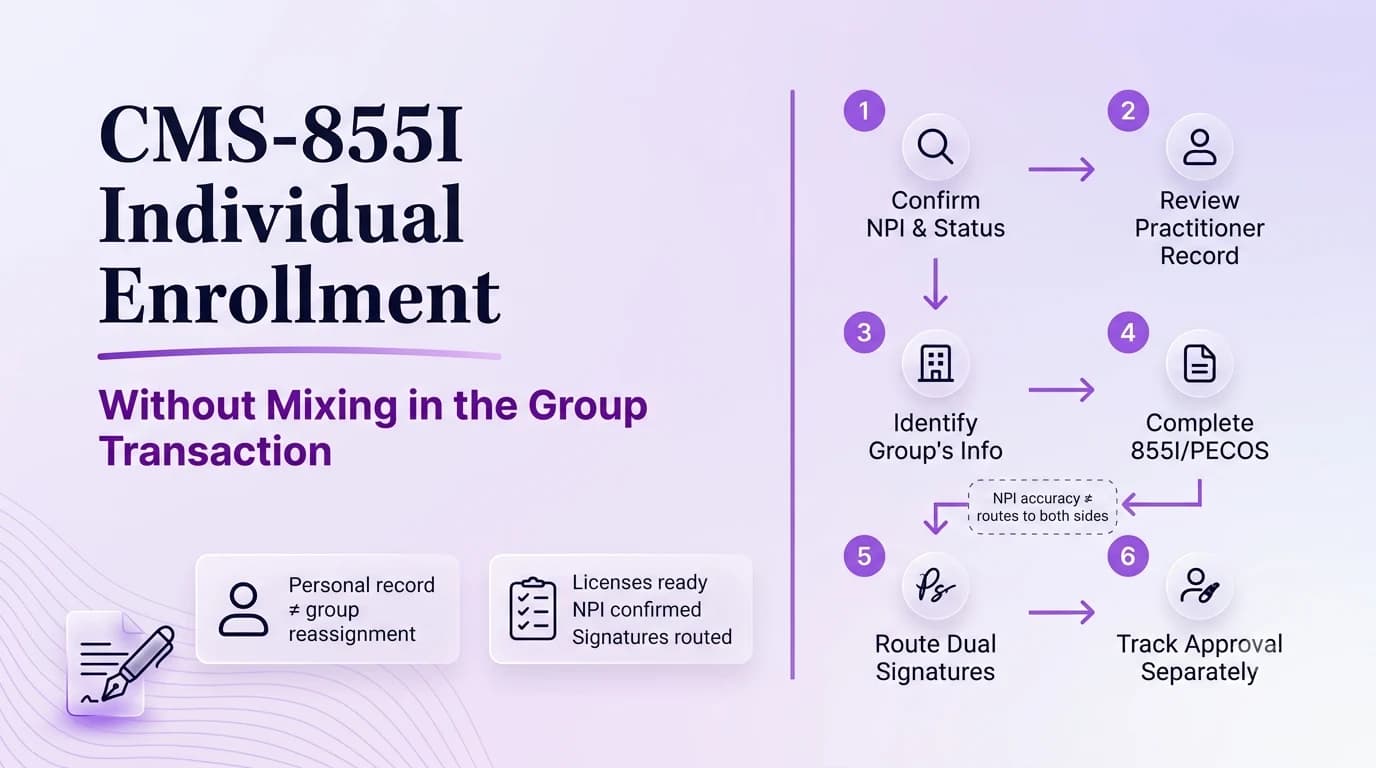
CMS-855I is the Medicare enrollment application for physicians and non-physician practitioners. The form establishes or updates the individual practitioner record; it should not be treated as a substitute for the group’s CMS-855B organization enrollment. Since CMS consolidated the standalone paper CMS-855R into CMS-855I, reassignment information can also appear in the individual paper workflow, which makes relationship tracking even more important. Before filing, confirm the clinician’s Type 1 NPI, legal name, provider type, licenses, practice locations, adverse-action disclosures, and existing Medicare enrollment. Then decide whether the transaction is an initial enrollment, change, revalidation, reactivation, reassignment, or a combination supported by the current instructions. The practitioner record and the group relationship should remain separately visible in the tracker.
Verify the practitioner identity and existing Medicare record before selecting initial enrollment
CMS-855I is the Medicare enrollment application for physicians and non-physician practitioners.
The revised 855I also captures reassignment information that used to be reported on CMS-855R.
An individual practitioner must be enrolled before Medicare payments can flow through the intended reassignment relationship.
Search the current Medicare and NPPES records first. A clinician who already enrolled through a prior employer may need a change, new state/jurisdiction action, location update, revalidation, or reassignment rather than a duplicate initial enrollment. Confirm legal name, Type 1 NPI, provider type, licenses, and existing PTAN/enrollment context where available. If an old enrollment is deactivated, identify the current reactivation requirements instead of submitting a second record without understanding the first. The transaction reason should match the real state of the practitioner’s Medicare record.
Build CMS-855I from the clinician’s current source documents and NPPES record
PECOS can be used instead of the paper form and is generally faster.
The application should reflect the practitioner’s own identifying, licensure, adverse-action, and practice information, not just the group’s data.
Separate the questions “Is the clinician enrolled?” and “Who receives payment for this clinician’s Medicare services?” They are connected, but they are not the same question.
Prepare the individual source packet: legal identity, NPI/taxonomy, licenses, education or qualification information where required, practice locations, contact information, banking/payment information if the practitioner receives direct payment, adverse legal actions/disclosures, and other provider-type evidence. Compare NPPES before submission. If the clinician recently changed legal name or added a license, resolve those upstream records first. A clean source packet makes the 855I answers repeatable across PECOS, paper, revalidation, and later MAC development requests.
Keep the individual practitioner separate from the group’s CMS-855B identity
Do not copy the group’s legal business name or Type 2 NPI into fields that describe the individual merely because the clinician owns the practice. The practitioner’s 855I record identifies the person; the group’s 855B identifies the organization. The two connect through reassignment and billing relationships. Keep separate identity sheets and link them. This separation becomes critical when the clinician works through multiple organizations, because the individual Medicare enrollment can remain active while group relationships change over time.
Use the consolidated reassignment sections without losing relationship visibility
Entering group information where the application is asking about the individual. The safe response is to stop the handoff until the source evidence and submitted answer tell the same story.
Adding a reassignment before confirming the group’s Medicare enrollment is active and correct. If one field changed, review the related identifiers, addresses, dates, and relationships instead of patching only the item mentioned in a portal message.
Forgetting a second practice relationship because the clinician works for more than one organization. The problem is not merely cosmetic: a mismatch can change which transaction is reviewed or where the request is routed.
Treating a reassignment approval as proof that every location or specialty detail is correct. This tends to surface later, when billing or scheduling discovers that a supposedly completed file still has an unresolved dependency.
CMS merged the standalone paper 855R into 855I. Use the current reassignment sections or PECOS workflow when the practitioner assigns benefits to an eligible group. Record the receiving organization, relationship effective information, and submission confirmation in its own tracker field. If the practitioner has another legitimate reassignment, do not remove it automatically. A consolidated form can carry more than one business purpose; the internal tracker should still show which part of the transaction affects individual enrollment and which part affects payment relationships.
Review every practice location and state/jurisdiction before signature
Individual npi and license: Keep the current version and enough history to show when it changed.
Current medicare enrollment summary: Use a filename that includes the provider or entity, document type, and the date that matters.
Reassignment details: Tie the document to the specific field or decision it supports.
Signed submission and approval letters: Record where it came from and when someone verified it.
Review service locations and states carefully. Medicare enrollment requirements can differ when a practitioner furnishes services in multiple jurisdictions, and certain provider types require separate state enrollment treatment. For telehealth, use current CMS location instructions rather than assuming the clinician is locationless. Compare locations with group sites and licensure. A practitioner location that is absent or stale can create claim problems even when the group location is correct. Record opening/closing dates so later updates use real operational events.
Archive the individual disposition and group relationship as separate activation evidence
After processing, save the practitioner’s enrollment disposition, effective date, PTAN/context if issued, and any location information separately from the reassignment outcome. Give billing a clinician-specific note showing whether the individual is active, which group relationship is active, and from what date. If the 855I transaction included both individual and reassignment changes, do not treat one approval line as proof that every component is complete without checking the final record. The file should make the practitioner’s personal Medicare status understandable even if the clinician changes groups later.
Operational checklist
- Confirm the clinician’s NPI and current individual enrollment status.
- Review the practitioner-specific record before adding the new employment relationship.
- Identify the group’s legal enrollment information and the intended reassignment.
- Complete the 855I/PECOS transaction with supporting licenses and practice data.
- Route signatures to both sides when the transaction requires them.
- Track the individual approval and reassignment outcome separately in the enrollment log.
Frequently asked questions
What is CMS-855I used for?
Physicians and non-physician practitioners use CMS-855I for individual Medicare enrollment and related transactions such as changes, revalidation, and current reassignment functions incorporated after CMS merged 855R into 855I.
Does CMS-855I replace the group’s CMS-855B?
No. CMS-855I is the individual practitioner record. The clinic or group organization uses CMS-855B/PECOS for its own enrollment. The records connect through relationships such as reassignment.
Should an already enrolled clinician submit another initial CMS-855I when joining a new group?
Usually the first step is to review the existing individual enrollment and determine what change, location, or reassignment is needed. Avoid duplicate initial records without understanding the current Medicare status.
Sources reviewed
Current CMS-855I PRA listing for physicians and non-physician practitioners.
CMS-855R is discontinued; reassignment data is now captured on CMS-855I.
Current CMS-855 application purposes and PECOS guidance.