CMS-855B for a New Group Practice: Build the Organization Record First
How a new clinic or group practice should build the organization Medicare record with CMS-855B or PECOS, including legal identity, ownership, locations, banking, and 2026 form changes.
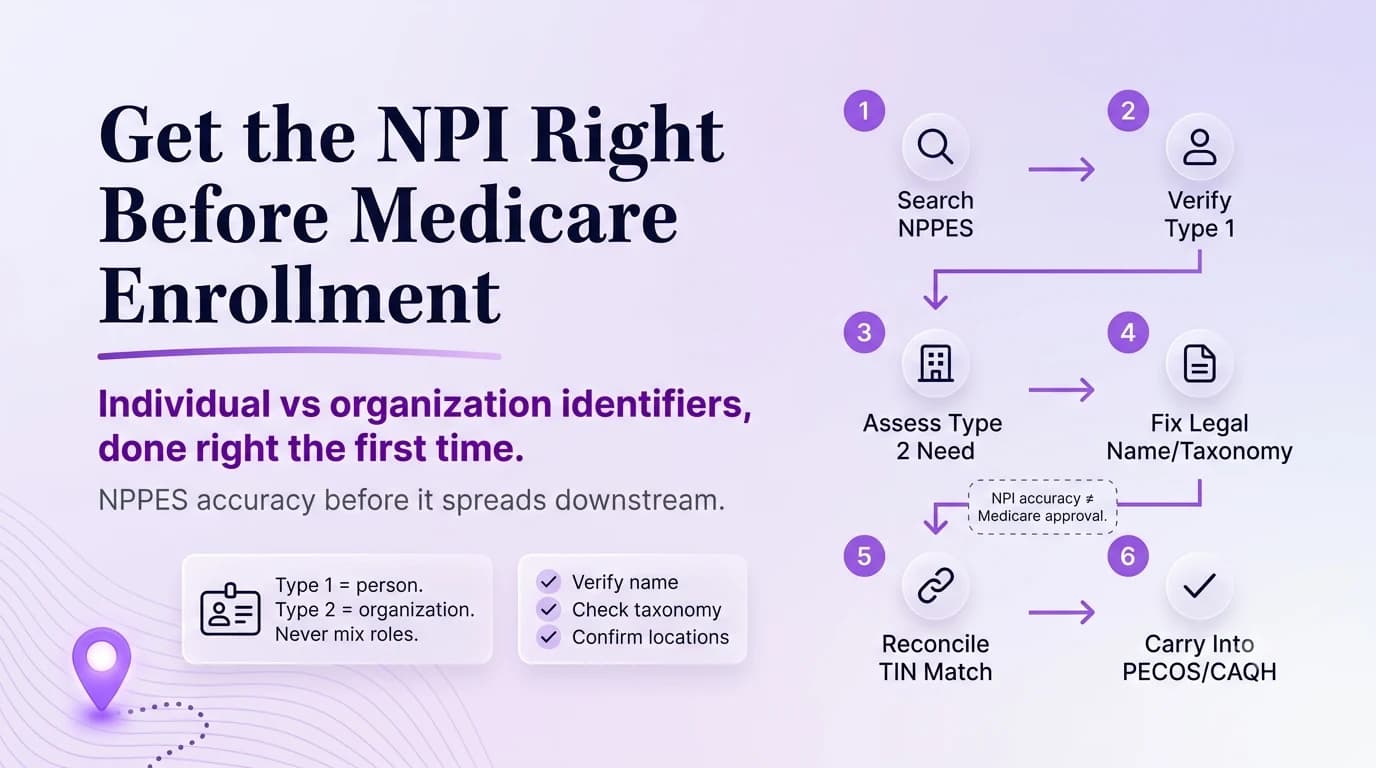
CMS-855B is the organization-side Medicare enrollment transaction for clinics, group practices, and certain other suppliers. A new practice should not begin by copying the owner’s individual data into the group form. Build the organization record first: exact legal business name, TIN, Type 2 NPI where required, ownership and managing control, service locations, authorized/delegated officials, banking/EFT information, and the relationships the group expects to establish with individual practitioners. In 2026 CMS revised CMS-855B and requires the revised paper form beginning August 3; the update includes changes such as group reassignment functionality and expanded practice-location types including telehealth. PECOS remains the preferred electronic route for most operations, but staff should still understand what the underlying organization enrollment is proving.
Build the organization identity before touching practitioner relationships
CMS-855B is used by clinics, group practices, and certain other suppliers to enroll, revalidate, or change Medicare enrollment information.
The 2026 CMS-855B revision added group reassignment capabilities and expanded practice-location types, including telehealth.
The organization enrollment depends on a Type 2 NPI and coherent legal-business information.
Create an organization source sheet with legal business name, TIN, Type 2 NPI, entity type, formation state, primary address, mailing address, service locations, ownership, managing officials, and the bank account intended for Medicare EFT. If a DBA exists, list it separately. Compare the identity sheet with the IRS/W-9 record and NPPES before entering PECOS. The group enrollment should describe the actual organization that will bill and receive payment. A physician owner’s Type 1 NPI, personal home address, or individual banking information should not be used as a substitute for missing organization data simply because the owner is also the first clinician.
Use the current CMS-855B or PECOS transaction instead of an old saved form
Physician and non-physician organizations generally do not pay the Medicare application fee.
The group’s approval does not automatically enroll each rendering practitioner.
The group file is the payment-and-organization spine. Practitioner files attach to it; they should not be used to compensate for an unfinished organization record.
If filing on paper, confirm the revision date before starting. CMS announced a revised 855B in 2026 and stated that the revised form must be used beginning August 3, 2026. The revision adds or changes several operational areas, including the ability for groups to establish, terminate, or change reassignments, removing the old physician-assistant employer relationship, and expanding location types to include telehealth. A shared drive containing last year’s PDF is therefore a real risk. For PECOS filings, follow the current online workflow and save a transaction export or summary so the office can reconstruct what was submitted.
Reconcile owners and managing control with legal records before signature
Ownership and managing control should be drawn as a chart before they are typed into the application. Record each owner, ownership percentage or other required interest, effective date, managing employee/official, and the document supporting the answer. If the practice is owned through another entity, show that relationship explicitly rather than flattening it into one name. The authorized official who signs should understand the enrollment representations. A common failure is to let a credentialing coordinator infer ownership from a cap table or website without confirming how the current CMS question defines reportable control.
Treat every location as an enrollment fact with its own opening or closing date
Submitting 855I practitioner transactions before the group identity is stable. If one field changed, review the related identifiers, addresses, dates, and relationships instead of patching only the item mentioned in a portal message.
Using a DBA where the form requires the legal business name. The problem is not merely cosmetic: a mismatch can change which transaction is reviewed or where the request is routed.
Omitting owners or managing employees who meet reporting requirements. This tends to surface later, when billing or scheduling discovers that a supposedly completed file still has an unresolved dependency.
Assuming the group record alone creates every clinician reassignment. A brief second-person check before submission is usually faster than answering a development request after the fact.
Build a location table with address, suite, location type, opening date, services, hours or contact details when required, and evidence that the group actually operates there. Separate physical, telehealth, correspondence, and other location functions according to current form/PECOS options. If a site will open after the application is filed, verify how CMS/MAC wants the effective date and supporting evidence handled rather than listing a future location casually. Once active, location changes are time-sensitive enrollment events, so the same table should become the practice’s maintenance record.
Prepare EFT and authorized-official evidence without mixing personal and business data
Formation documents: Use a filename that includes the provider or entity, document type, and the date that matters.
Irs tax identity evidence: Store it with the transaction rather than in a personal downloads folder or one coordinator’s inbox.
Type 2 npi: Tie the document to the specific field or decision it supports.
Ownership/control roster: Record where it came from and when someone verified it.
Location and eft records: Preserve the prior version when an effective-date sequence could matter in a later review.
EFT and signer records deserve their own pre-submit review. Confirm the bank account belongs to the appropriate payment entity and that the routing/account evidence satisfies the current enrollment requirements. Keep the bank evidence securely and limit access. Separately verify the authorized or delegated official relationship and electronic access needed for PECOS signature. A preparer can assemble data without being the person legally authorized to certify it. Discovering that distinction at the signature screen can delay a filing that otherwise looked complete.
Finish the group record before calling individual practitioners fully connected
An approved group record does not automatically activate every clinician. After the organization enrollment is processed, confirm the group’s Medicare identifiers and effective information, then establish or verify the individual practitioner enrollments and reassignments that make the billing relationship work. Use separate tracker rows for group enrollment and each practitioner-to-group relationship. That structure prevents the office from telling billing “the group is approved, so everyone is good” when a specific physician or non-physician practitioner has not yet been linked to the organization.
Operational checklist
- Finalize the legal entity, TIN, bank account, and Type 2 NPI.
- Assemble ownership, managing-control, location, and contact information.
- Open the group enrollment in PECOS or use the current 855B when paper is necessary.
- Submit the organization record and respond to MAC development promptly.
- Add practitioner reassignments using the current CMS workflow.
- Keep the group record as a maintained asset rather than a one-time startup form.
Frequently asked questions
Who uses CMS-855B?
Clinics, group practices, and certain other organizational suppliers use CMS-855B for Medicare enrollment, revalidation, and changes. Individual physicians and non-physician practitioners use the applicable CMS-855I/PECOS practitioner workflow instead.
Was CMS-855B revised in 2026?
Yes. CMS announced a revised form and required its use beginning August 3, 2026 for paper submissions. The revision includes group reassignment functionality and expanded practice-location types such as telehealth.
Does group approval mean all clinicians can bill through the group?
No. Individual practitioner enrollment and the reassignment or group relationship must also be established. Track the organization and each practitioner relationship separately.
Sources reviewed
Current CMS-855B form listing; 2026 revision for clinics/group practices and certain suppliers.
2026 enrollment fee, 855 form roles, ordering/certifying rules, and current enrollment education.
CMS-855R is discontinued; reassignment data is now captured on CMS-855I.