Medicare Enrollment Application Fee in 2026: Who Pays and When
The Medicare enrollment application fee is $750 in calendar year 2026 for institutional providers and suppliers subject to the fee. Physicians, non-physician practitioners, and their organizations are generally exempt.
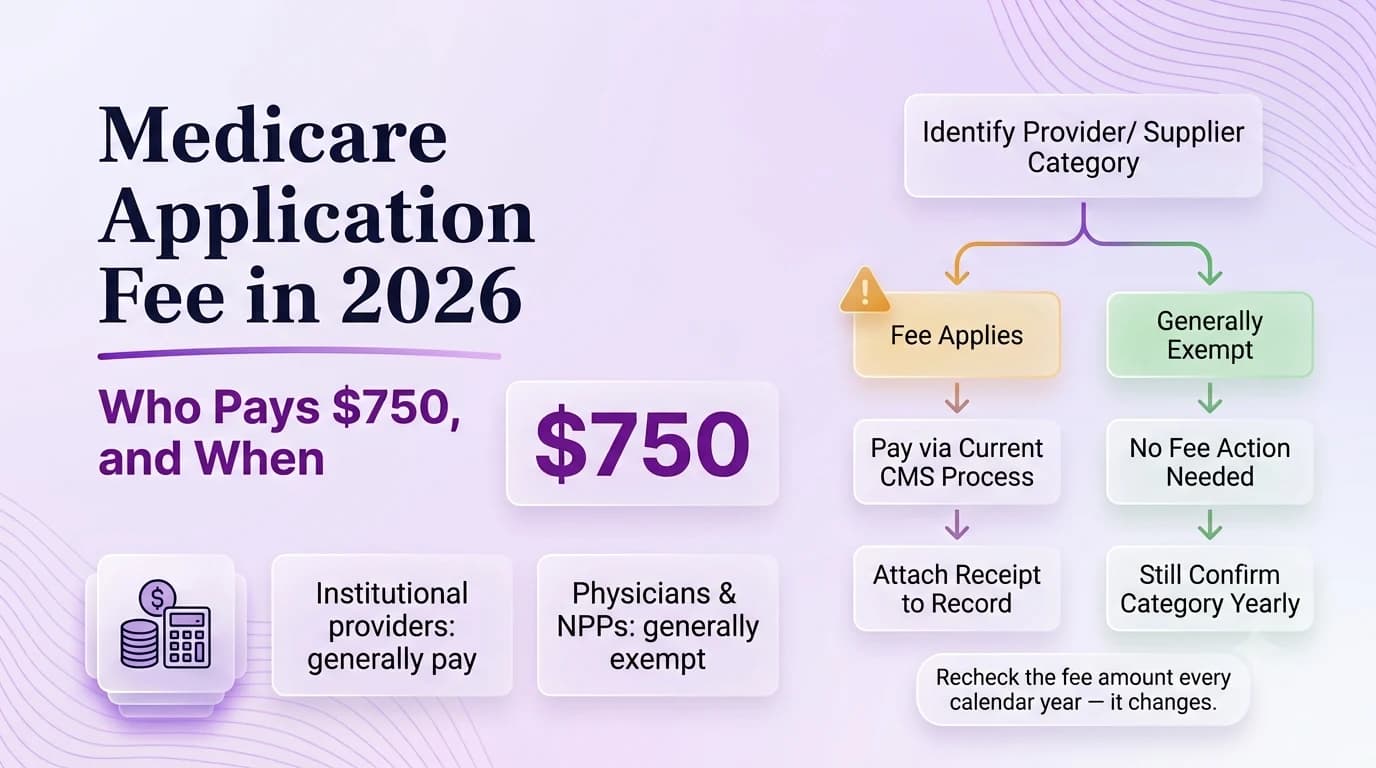
The Medicare enrollment application fee is not a universal charge for every PECOS filing. CMS sets the amount annually, and for calendar year 2026 the fee is $750 for institutional providers and suppliers that are subject to the requirement. Physicians, non-physician practitioners, physician organizations, and non-physician practitioner organizations are generally not required to pay the application fee. Before anyone reaches for a credit card, identify the provider or supplier type, transaction, and current CMS fee matrix. The office should save the fee decision and payment receipt when applicable because the dollar amount alone does not prove the application actually required payment. Do not copy a prior year’s amount or assume a group owes the fee merely because it has a Type 2 NPI.
Confirm the 2026 amount before using a prior-year fee worksheet
CMS lists the 2026 Medicare enrollment application fee as $750.
Physicians, non-physician practitioners, physician organizations, non-physician organizations, and Medicare Diabetes Prevention Program suppliers do not pay the enrollment application fee.
Institutional providers and certain suppliers, including DMEPOS suppliers and opioid treatment programs, generally do pay the fee for specified enrollment actions.
CMS updated the Medicare enrollment fee for 2026, and current Medicare provider-enrollment material lists the CY 2026 application fee as $750. Put the calendar year next to the amount in any internal checklist. A worksheet that says only “Medicare fee: $750” will become wrong when CMS adjusts the amount for a later year. Staff should verify the current CMS enrollment fee information at the time of filing, particularly for applications prepared late in December or early January when an annual amount changes.
Determine whether the provider or supplier type is actually subject to the fee
The fee question depends on provider/supplier type and transaction, not simply whether the application is new.
Payment, when required, should be tied to the correct application and preserved in the file.
The fee is a classification problem before it is a payment problem. Identify the enrollment type first; do not let a generic “$750” note drive the workflow.
The key question is whether the applicant belongs to a provider or supplier category subject to the fee. CMS uses application-fee rules for institutional providers and suppliers and maintains a fee matrix/process. The practice should identify the exact provider/supplier type and enrollment transaction before deciding. Do not infer the answer from the size of the business, the presence of an LLC, or whether the applicant uses CMS-855B. Different organizations can use Medicare enrollment forms without sharing the same fee treatment.
Separate physician and practitioner organizations from fee-bearing institutional suppliers
Physicians and non-physician practitioners—and physician or non-physician practitioner organizations—are generally exempt from the Medicare application fee. That distinction is important for small medical and behavioral-health groups that assume an “organization” automatically means institutional supplier. Record the exemption rationale in the transaction checklist when the office reviewed the fee question, especially if a staff member or consultant expected payment. A documented no-fee decision prevents another person from paying unnecessarily just to move the PECOS workflow forward.
Pay through the current CMS process only after the application context is clear
Paying a fee that does not apply because staff use a generic checklist. A copied prior application is especially risky here because an old file can be internally consistent and still be wrong for the current facts.
Failing to budget the fee for a supplier category that is subject to it. The safe response is to stop the handoff until the source evidence and submitted answer tell the same story.
Using an old annual fee amount. If one field changed, review the related identifiers, addresses, dates, and relationships instead of patching only the item mentioned in a portal message.
Losing the payment receipt and then struggling to connect the payment to the application. The problem is not merely cosmetic: a mismatch can change which transaction is reviewed or where the request is routed.
If the fee applies, use the current CMS payment pathway referenced in the enrollment process and tie the payment to the correct application. Confirm payer name, provider/supplier information, amount, date, and receipt. Do not send money based on an email link from an unverified source. If the applicant believes a hardship exception or waiver process may apply, follow current CMS instructions rather than omitting payment and hoping the contractor will ask later. The enrollment tracker should identify the fee as a dependency with its own evidence.
Save the payment evidence with the exact enrollment transaction
Provider/supplier classification: Use a filename that includes the provider or entity, document type, and the date that matters.
Current-year fee reference: Store it with the transaction rather than in a personal downloads folder or one coordinator’s inbox.
Payment receipt if applicable: Tie the document to the specific field or decision it supports.
Submission tracking id: Record where it came from and when someone verified it.
Finance reconciliation note: Preserve the prior version when an effective-date sequence could matter in a later review.
Save the receipt with the submitted application and note the transaction it supports. A practice with multiple pending enrollments should not maintain one folder called “Medicare fee receipts” without application context. If the MAC develops for missing payment evidence, the coordinator can respond immediately. If a duplicate or mistaken payment occurs, the same record helps research it. For exempt applications, save the source or fee-matrix review date so the absence of a receipt is an intentional decision rather than an unexplained missing document.
Recheck the fee rule for future years instead of hard-coding $750 into the SOP
Treat the fee amount and category rules as annual maintenance items. At the beginning of each calendar year, update the SOP link to the current CMS material and remove the prior dollar amount from reusable templates. Training should teach the decision process—provider/supplier type, fee applicability, current annual amount—rather than a memorized number. That approach survives both inflation updates and changes in the practice’s service lines. A small physician group that later opens a fee-bearing institutional supplier operation may need different treatment even though the credentialing team is the same.
Operational checklist
- Identify the Medicare provider/supplier category.
- Check the current CMS fee guidance for the year of submission.
- Confirm whether the specific transaction triggers the fee.
- Pay through the current CMS process only when applicable.
- Attach the receipt or payment reference to the enrollment record.
- Review annual fee updates before carrying a prior-year amount into the new compliance calendar.
Frequently asked questions
What is the Medicare enrollment application fee for 2026?
CMS lists the calendar year 2026 Medicare application fee as $750 for institutional providers and suppliers that are subject to the fee.
Do physicians and non-physician practitioners pay the Medicare application fee?
They are generally exempt, as are physician and non-physician practitioner organizations. Confirm the applicant’s exact provider/supplier type and current CMS fee guidance before deciding.
Should the practice keep $750 in its SOP for future years?
No. CMS updates the amount annually. Keep a link to the current source and verify the calendar-year fee when preparing each applicable enrollment.