CAQH Re-Attestation: 120 Days for Most Providers, 180 Days in Illinois
A CAQH re-attestation workflow that reflects the current 120-day cadence for most providers and 180-day cadence for providers practicing in Illinois, with document and change controls built in.
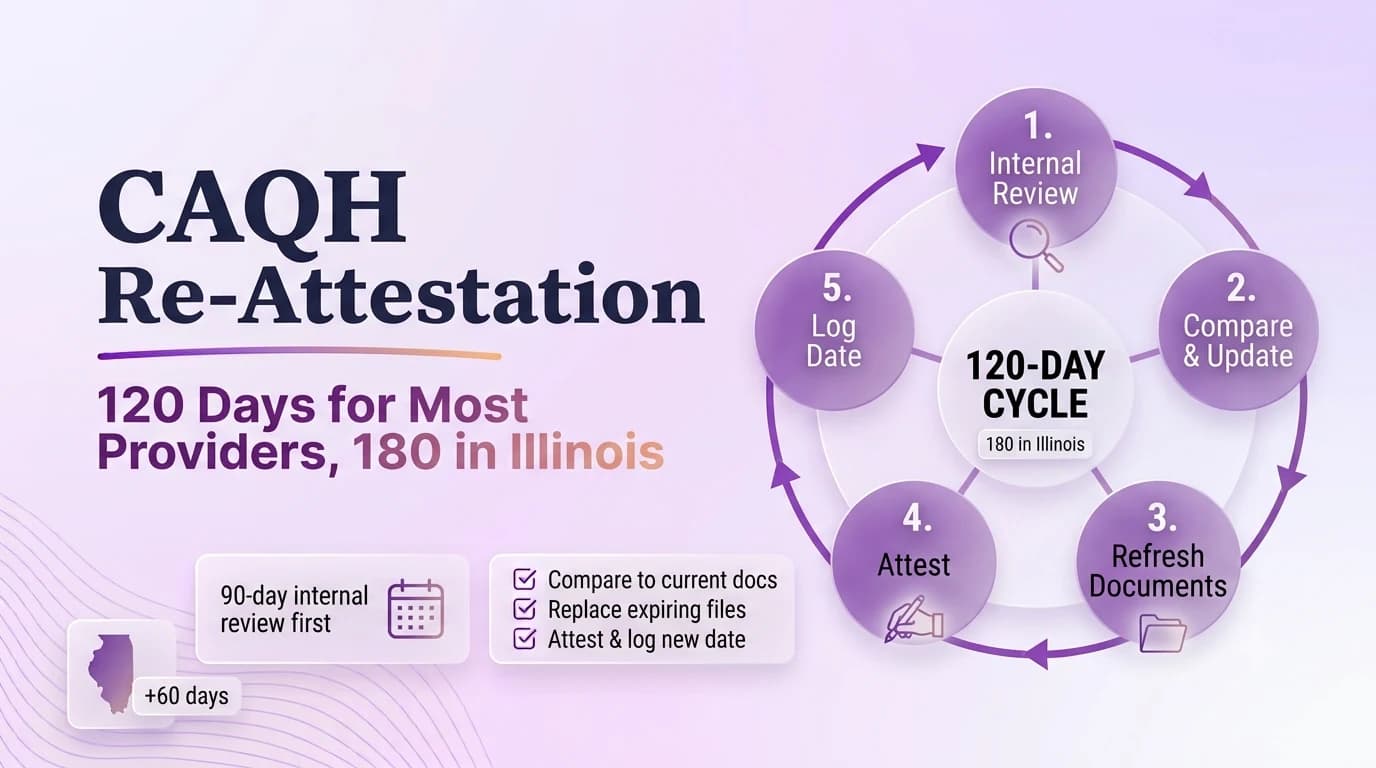
CAQH re-attestation is easy to postpone because the profile may look unchanged. The attestation itself is the provider’s confirmation that the information is still true, correct, and complete, and current CAQH guidance uses a 120-day cadence for most providers and 180 days for providers practicing in Illinois. A good workflow starts before the deadline. Review changes in licensure, malpractice coverage, work history, locations, contact details, taxonomy, disclosures, and supporting documents; update the profile; then attest so authorized organizations can see the current information. The maintenance record should save the last attestation date, next expected date, person who prepared changes, and evidence of completion. Do not label every CAQH task “120 days,” because the Illinois exception matters and other CAQH location-review requests can run on different clocks.
Determine the provider’s actual attestation cadence before setting reminders
CAQH materials describe credentialing attestation on a 120-day cycle.
The Provider Data Portal shows time remaining until the next attestation and can show an expired-attestation state.
Changes made after an attestation may require another re-attestation before they appear as completed activity.
For most providers, use 120 days as the CAQH re-attestation interval; for providers practicing in Illinois, current CAQH quick-reference guidance states 180 days. Record the cadence explicitly in the master tracker rather than using one global recurring task for the whole practice. If a provider practices in Illinois and elsewhere, confirm the cadence displayed in the profile and current CAQH guidance rather than improvising. Use an internal preparation reminder before the expected deadline so there is time to obtain replacement documents. The goal is to enter the attestation window with a reviewed file, not to discover an expired license the day the reminder arrives.
Start the review from changes since the last attestation, not from a blank profile
Supporting documents can expire independently of the attestation date.
A clean re-attestation should confirm both data accuracy and document currency.
Do the data review before the portal says “expired.” A 120-day attestation cycle works best when the internal control runs earlier.
Run a “what changed?” intake first. Ask about new or closed locations, employer or group changes, licenses, specialty or taxonomy, board status, malpractice coverage, controlled-substance credentials where relevant, work-history additions, sanctions/disclosures, and contact information. Compare the answers with HR and credentialing records. Then review the CAQH summary for fields staff might not remember to mention. This is faster and more accurate than re-reading every field without context. If nothing changed, the review still has value because the provider is confirming that the unchanged data remain accurate.
Refresh expiring documents before they turn a complete profile incomplete
Check document expirations early. A profile can contain accurate narrative data and still become unusable to organizations if a required supporting document is expired or rejected. Replace licenses, malpractice evidence, DEA or other requested documents as they renew and verify the platform’s document status. Keep a local source copy with the effective and expiration dates. If a document will renew shortly after attestation, calendar that replacement separately; re-attestation does not remove the need to update an expiring attachment between routine cycles.
Review locations and employment history for operational changes that staff may miss
Attesting without checking licenses, liability coverage, and locations. This tends to surface later, when billing or scheduling discovers that a supposedly completed file still has an unresolved dependency.
Updating a field after attestation and assuming the profile history already reflects it. A brief second-person check before submission is usually faster than answering a development request after the fact.
Letting the 120-day date and document expiration dates live on separate calendars. When this happens, correct the source record first and then update the downstream copies that are actually affected.
Assigning the reminder to a shared inbox with no named owner. Do not bury this under a generic “pending” label. Name the blocker, the owner, and the next action.
Locations and work history deserve an operational review. A clinician may stop seeing patients at a site while the payer directory and CAQH profile still show it. Conversely, a new site can open through scheduling before credentialing staff hear about it. Compare the location list with the practice’s current service map, and move historical employment/location information into the appropriate historical sections rather than leaving inactive sites as current. Record opening and closing dates carefully. These updates can affect payer directories and network records, so trigger payer-specific change work where required instead of assuming CAQH alone updates every plan.
Attest after edits so authorized organizations can see the updated profile
Caqh dashboard date: Use a filename that includes the provider or entity, document type, and the date that matters.
Document-expiration list: Store it with the transaction rather than in a personal downloads folder or one coordinator’s inbox.
Profile change log: Tie the document to the specific field or decision it supports.
Attestation confirmation: Record where it came from and when someone verified it.
Payer follow-up notes: Preserve the prior version when an effective-date sequence could matter in a later review.
After making changes, complete the Review & Attest step. CAQH guidance notes that updated profile information becomes available to authorized organizations after attestation. Save the date and status evidence in the maintenance file. If a staff member prepares the updates, the provider should still understand the attestation being made; do not treat delegated data entry as permission to attest inaccurately. When the profile shows an unresolved document or validation issue, capture that as a follow-up rather than calling the entire maintenance event complete merely because the attestation action was submitted.
Keep payer recredentialing and CAQH re-attestation as separate calendar items
A payer’s recredentialing cycle is not the same as CAQH re-attestation. A plan may use current CAQH data during its own review, but it can still require a separate questionnaire, disclosure, contract update, or directory validation. Keep separate rows in the calendar for CAQH and each payer requirement. This makes the CAQH cycle a source-data maintenance control rather than a false proxy for network status. It also helps the office diagnose responsibility: an expired CAQH profile is an upstream problem; a payer that has not completed recredentialing is a separate downstream task.
Operational checklist
- Create a recurring 90-day internal review ahead of the 120-day credentialing attestation point.
- Compare the profile with current licenses, insurance, CV, and practice locations.
- Replace expiring documents before attestation when possible.
- Make needed data changes and verify they are saved.
- Complete re-attestation and capture the new last-attested date.
- Escalate any payer request that continues to show stale CAQH data after the profile is current.
Frequently asked questions
Is CAQH re-attestation always due every 120 days?
No. Current CAQH quick-reference guidance states every 120 days for most providers and every 180 days for providers practicing in Illinois. Use the cadence applicable to the provider and current profile guidance.
If nothing changed, does the provider still need to re-attest?
Yes. Re-attestation is the provider’s confirmation that the profile remains true, correct, and complete. The review should still verify documents and operational facts before attesting.
Does CAQH re-attestation complete payer recredentialing?
No. Payers control their own recredentialing and network maintenance. CAQH may provide source data, but a plan can require separate steps and issue its own decision or effective date.