Missed Medicare Revalidation: What Deactivation Means Operationally
What happens operationally after a Medicare revalidation is missed, how deactivation can interrupt billing, and how to organize reactivation work without guessing at retroactivity.
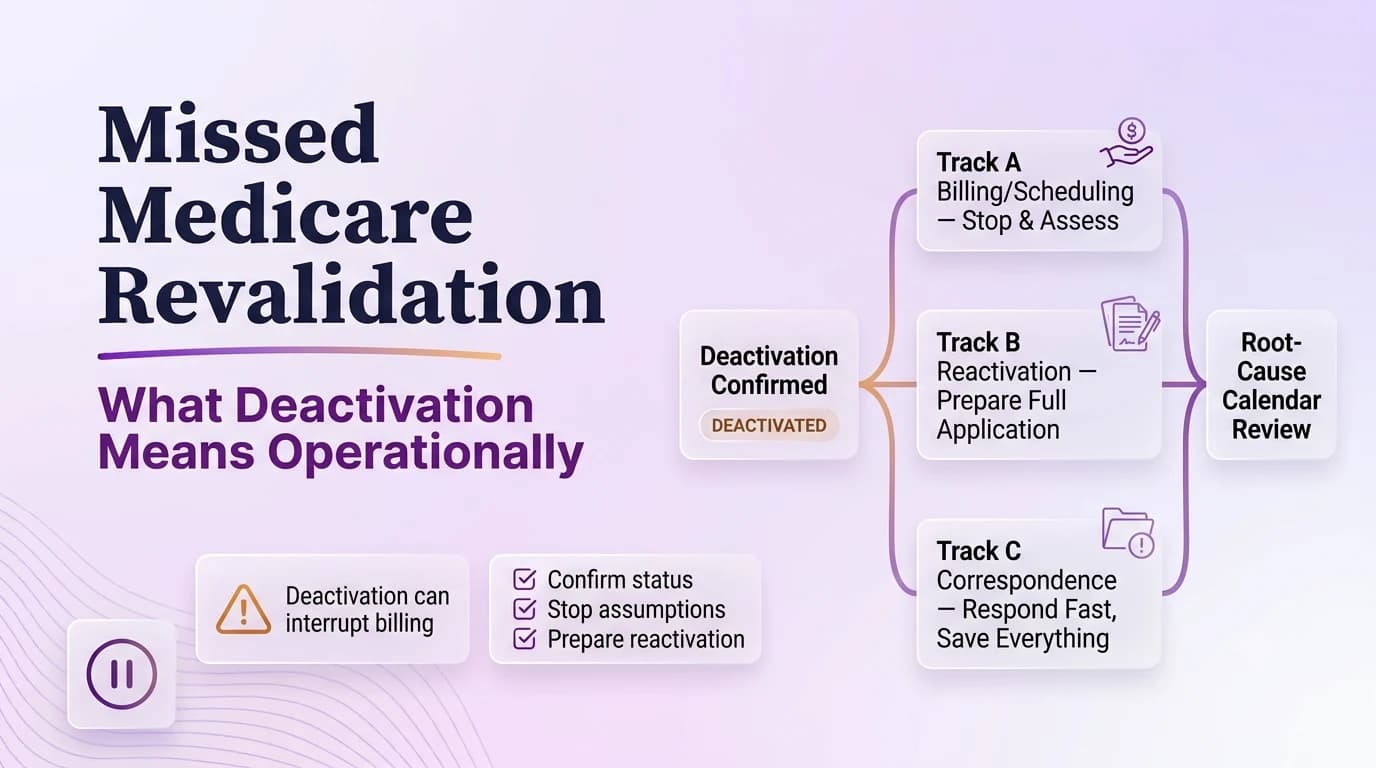
Missing a Medicare revalidation is not the same thing as receiving an ordinary development request. If the enrollment is deactivated, the practice can face a billing interruption while it completes the work CMS or the MAC requires to restore the record. The response should begin with the actual enrollment status and the contractor notice, not with assumptions about whether claims will be paid later. Pull the PECOS record, identify the affected provider or supplier and enrollment, confirm the due date and deactivation information, and separate services already furnished from future scheduling decisions. Then build a complete reactivation or revalidation file using current data. The practice also needs a revenue-cycle plan for dates of service that fall into any gap rather than promising clinicians that approval will automatically cure every claim.
Confirm whether the enrollment is late, deactivated, or facing another action
CMS says failing to revalidate on time can lead to a hold on reimbursement or deactivation of Medicare billing privileges.
If billing privileges are deactivated, CMS says the provider must submit a complete Medicare enrollment application to reactivate.
CMS states Medicare will not reimburse services furnished during the period of deactivation.
Start with the notice and the current PECOS/MAC status. Record the provider or supplier name, NPI, PTAN where applicable, enrollment state or jurisdiction, due date, date the MAC says the record was deactivated, and the action requested. Do not use “terminated” and “deactivated” interchangeably unless the notice does. Different actions can have different procedural consequences. Save the original correspondence in the file and route it to billing leadership immediately if an interruption has already started. The credentialing coordinator’s first deliverable is a dated fact sheet that explains what the contractor record actually shows, not a prediction about how quickly it will be fixed.
Freeze guesswork about billing dates until the MAC record is understood
CMS does not grant routine extensions to revalidation due dates.
The operational response should involve credentialing, billing, scheduling, and revenue-cycle teams together.
When deactivation occurs, the credentialing event becomes a revenue-cycle incident. Treat it with the same urgency and documentation discipline.
Create a service-date exposure list while the enrollment team works the application. Identify claims already submitted, unbilled encounters, scheduled Medicare patients, and any locations or reassignment relationships tied to the affected enrollment. The practice may need to hold, correct, or later resubmit claims depending on the final contractor action and allowed billing period. Do not represent a future approval as guaranteed retroactive coverage. Instead, keep the clinical and billing teams informed of the known status and escalate payer-policy questions to the MAC or appropriate compliance resource. This prevents staff from making patient promises based on a hoped-for effective date.
Rebuild the application from current data rather than resubmitting the old snapshot
A missed cycle is a poor time to simply copy the prior revalidation. Review legal name, TIN, ownership/control, practice locations, licenses, banking/EFT, adverse legal actions, managing employees or officials where applicable, and all other data required for the provider type. If a location closed or an owner changed during the period the record was not maintained, the new filing must reflect current facts and may also reveal separate change-reporting work. Gather supporting documents before submission and make sure the authorized signer is available. A complete current file is usually a better recovery strategy than rushing an incomplete transaction because billing is already under pressure.
Track the reactivation submission and every contractor development request closely
Calling the issue a “late renewal” and underestimating the billing consequence. A copied prior application is especially risky here because an old file can be internally consistent and still be wrong for the current facts.
Continuing to schedule Medicare services without understanding the deactivation period. The safe response is to stop the handoff until the source evidence and submitted answer tell the same story.
Submitting a partial update instead of the required complete enrollment transaction. If one field changed, review the related identifiers, addresses, dates, and relationships instead of patching only the item mentioned in a portal message.
Failing to investigate why the deadline was missed. The problem is not merely cosmetic: a mismatch can change which transaction is reviewed or where the request is routed.
Once submitted, monitor the case more actively than a routine maintenance item. Save the submission confirmation and check PECOS and MAC correspondence using the appropriate channel. If the contractor develops for additional information, log the request date, response deadline, exact items requested, owner, response date, and evidence sent. Keep one versioned transaction folder so multiple staff do not send conflicting corrections. If the MAC provides a call reference or specific instruction, record it. The goal is to shorten internal response time even though the practice cannot control the contractor’s processing timeline.
Reconcile claims by date of service after the enrollment record is restored
Deactivation notice: Tie the document to the specific field or decision it supports.
Revalidation due-date history: Record where it came from and when someone verified it.
New enrollment submission: Preserve the prior version when an effective-date sequence could matter in a later review.
Claim-impact list: Keep the current version and enough history to show when it changed.
Root-cause action plan: Use a filename that includes the provider or entity, document type, and the date that matters.
After the enrollment is restored, ask the MAC record—not memory—to define the effective or reactivation status that matters for billing. Then compare that result with the exposure list. Billing can work claim by claim or date range using the contractor’s instructions and applicable filing limits. Record which claims were resubmitted, rejected, or require another action. If reassignment or location records were also affected, verify those relationships before assuming all claims should flow normally. A successful enrollment transaction is only part of recovery; the financial closeout is complete when the practice understands the impact on the affected dates of service.
Fix the maintenance failure that allowed the revalidation to be missed
Finally, conduct a short root-cause review. Was the due date absent from the calendar, assigned to a former employee, mistaken for a five-year anniversary estimate, hidden in an unmonitored mailbox, or never escalated when documents were missing? Fix the control that failed. Store the next revalidation information from the current CMS source, set an earlier preparation date, assign a backup owner, and add a monthly open-item review. Also capture event-driven changes separately so the practice does not wait for the next revalidation to clean up locations or ownership. The recovery should make the next cycle boring.
Operational checklist
- Confirm the exact deactivation status and effective date with source records/MAC.
- Stop assumptions in billing and scheduling until the impact is understood.
- Prepare the complete enrollment application required for reactivation.
- Respond quickly to contractor development and preserve all correspondence.
- Reconcile affected claims and patient-service dates with the billing team.
- Perform a root-cause review of the revalidation calendar and ownership controls.
Frequently asked questions
Does missing revalidation automatically mean Medicare enrollment is permanently revoked?
No. CMS/MAC notices distinguish actions such as deactivation from revocation. Read the actual notice and current enrollment status and follow the required revalidation or reactivation process rather than assuming the most severe outcome.
Will reactivation automatically make every claim in the gap payable?
Do not assume that. The final enrollment status, effective/reactivation dates, claim rules, and filing limits control. Build a date-of-service exposure list and reconcile claims after the contractor action is clear.
What should the practice fix after recovering from a missed revalidation?
Correct the maintenance control that failed: due-date source, preparation lead time, owner, backup owner, correspondence monitoring, escalation, and monthly review. Do not treat the incident as a one-time calendar mistake.